Your June 2013 Mosquito Lagoon & Indian River Fishing Report
Published: Sat, 06/01/13
| Newsletter Issue # 46 Fishing Forecast |
June1, 2013 | ||||
Mosquito Lagoon & Indian River Fishing | |||||
Mosquito Lagoon and Indian River
In east Central Florida, now is the time to be on the water at first light if you want to catch large gator sea trout.
Between mid May and the end of June, the larger "sow" females will be shadowing schools of mullet in the Mosquito Lagoon and Indian River Lagoon systems. The critical time to intercept them is EARLY! By mid morning the bright daylight pushes many of the larger sea trout into deeper waters. These early morning fishing trips can offer smashing topwater action with high floating hard baits worked with a lot of action. When worked properly, the sloshing vibrations coupled with rattle chambers will get the attention of the early feeders. Since finger mullet are the primary forage for the bigger females, you need to first find the schools of mullet if you want to increase your chances of catching a gator trout. Because finger mullet usually hold in in an area for days or even weeks, it's a good idea to get on the water the afternoon or evening before you decide to fish to locate where the bait pods are schooling. If you crave topwater action like I do, get out and wade the edges of submerged bars or anywhere you find mullet schools. 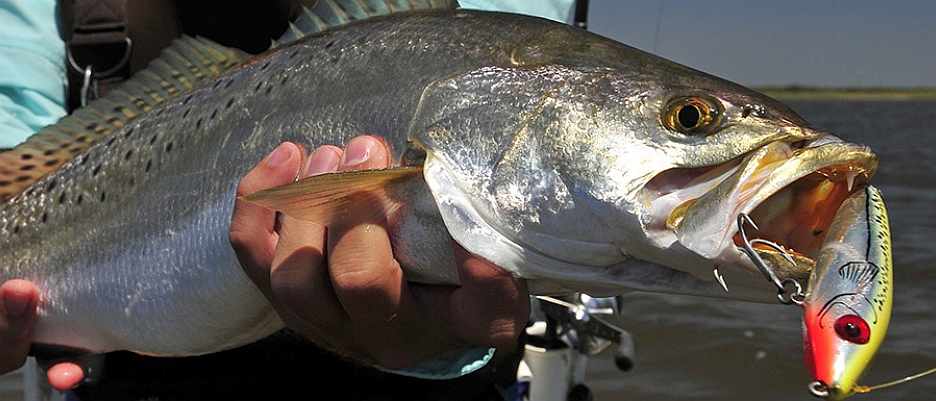 Wade slowly and use stealth tactics to go unnoticed and you'll get more strikes. Some hard baits of choice that create a good disturbance are the Rapala Skitter Walk, the Heddon Zara Spook, Bomber's Badonk-A-Donk High Pitch or A-Salt® Popper, Strike King's KVD Sexy Dawg and the Storm Rattlin' Chug Bug. They all work well and will catch their share of fish when worked properly. Large schools of redfish are all over the flats of Mosquito Lagoon. The north end of the Mosquito Lagoon has been hot for big redfish all around the islands from Ponce Inlet south to Edgewater.
Although most of the larger redfish are being caught on cut baits; shrimp, jigs or jigs tipped with shrimp are also producing some nice reds, especially close to the oyster bars and around the docks. The area North of the Ponce Inlet around Rose Bay and Spruce Creek has also been producing some nice reds and sea trout all this past week. Some nice sea trout up to 6 pounds are now being caught around the docks in the Northern end of the Lagoon. The South end of the Mosquito Lagoon is still brown with algae, but if you pole the shallow flats slowly, you can spot the reds and sea trout cruising just above the sea grass or laying in the grass around the potholes. Right now, saltwater Assassin or soft plastic shrimp baits in the clear or "drunk monkey" color seem to be working best. Rig them on a 3/0 weighted worm hooks smeared with a little Pro-Cure or Bang scent to sweeten up the bait. If you cast the bait directly in front of the fish you will usually get a hookup. Live shrimp will do the same job but the pinfish will beat them to death unless you cast directly in front of a fish. Blind casting is definitely out of the question with live shrimp this time of the year. In the south Indian River around Rockledge and Coco down through Melbourne, there are lots of sea trout along the drop offs and around the shorelines. Fishermen using saltwater assassin soft plastic paddletail baits or live finger mullet are getting sea trout up to 10 pounds in that area and also in the area just North of the Pineada Causeway. Down around the Grand Canal area, some tarpon are just starting to show up in the river along with some nice sized sheepshead. Live fiddler crabs on small light hooks weighted with a small split shot should hook you up with a "head". There are a surprising number of feeder creeks that flow into the Indian River Lagoon System in Brevard and Volusia counties and starting in June, all of them will hold tarpon from 3 pounds to 30 pounds or more.
Playalinda Beach & South Surf Fishing
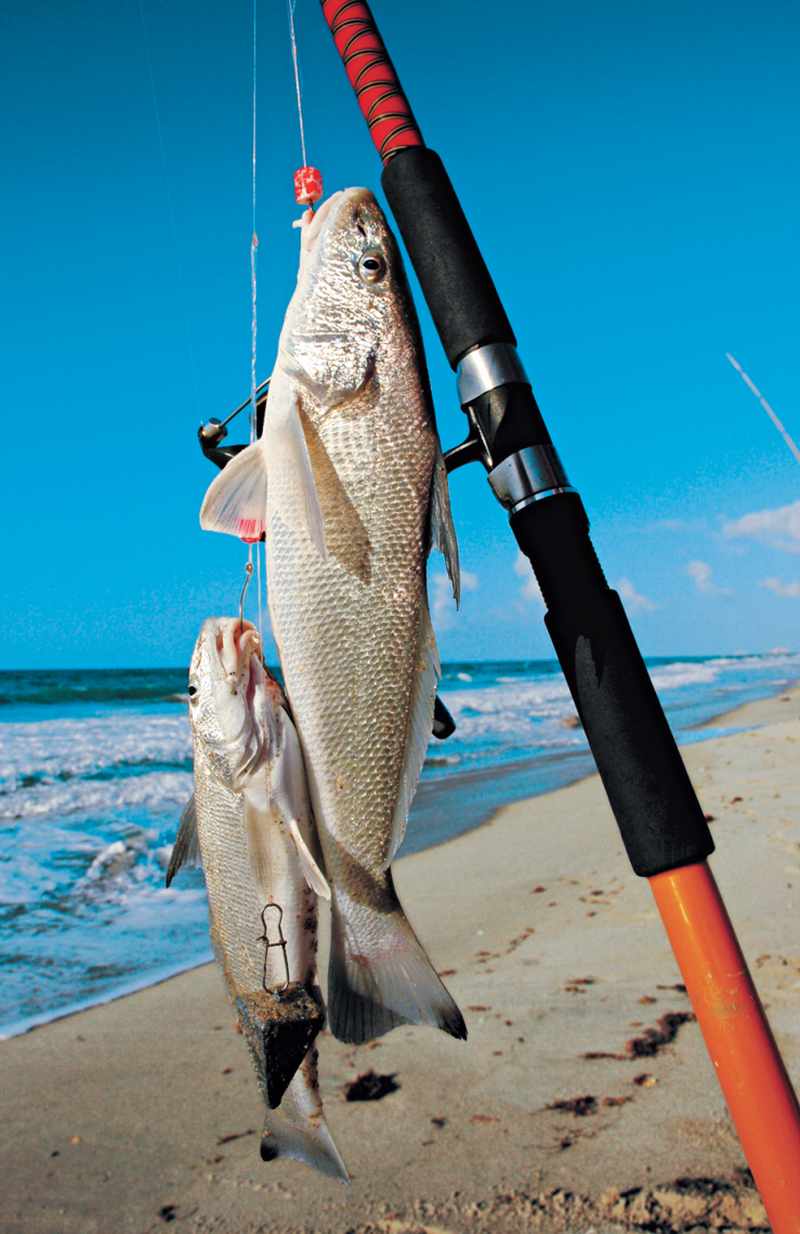 June is normally when the whiting start their pre-spawn feeding mode and become thick along the beaches in the surf in most areas of Central Florida.
Small pieces of shrimp, sand fleas and cut clams are the baits of choice for most surf fishermen who use long surf rods with two or three dropper rigs and 2 oz. to 6 oz. pyramid sinkers.
The best bite will occur early in the morning from the middle to the end of the incoming tide, but whiting will bite throughout the day. Most of the fish will be 12" to 15" long, but don't be surprised to catch some "bull" whiting in the 19" category. If you plan on using sand fleas for bait , you have the potential of picking up a pompano for dinner along with some whiting. On a long surf rod Whiting don't put up much of a fight but you can have a lot of fun and catch some nice fish wading and flipping short casts into the first or second trough using a 7 foot spinning rod and a barrel sinker rig.
You don't have to cast a country mile to catch some nice whiting in the surf. ________________________ Near Offshore Fishing
From now through July small craft fishermen should be able to catch king mackerel and tripletail within a few miles off the beach outside of Port Canaveral. Most of the kings will be in the 10 to 15 pound range but larger 20 to 30 pound kingfish are not uncommon. Normally the smaller kings will be closer to the surface chasing threadfin herring during the early morning hours. Later in the afternoons when the glass minnows come in, Spanish mackerel and false albacore will be drawn in to feed on them and will in turn attract the larger "smoker" kingfish. Slow trolling small mullet around the threadfin herring schools is a good way to pick up the smaller king mackerel.
Look for tripletail along the channel marker buoys or other floating debris outside of the port and toss a live shrimp, DOA shrimp or small jig at them to catch one.
June is one of the peak months for bull dolphin off the east coast of Florida. Trolling a medium size ballyhoo at 4 to 6 knots with a cupped head in front of the bait should get you a hookup if they are in the area.
 The cupped head pushes a lot of water and creates a nice bubble trail with lots of bubbles that get the dolphin fired up.
You can also skip a naked ballyhoo over the surface on an outrigger or put them on a chain weight to get them down if the fish are deep.
Out of Port Canaveral you have a good possibility of running into a wahoo or a kingfish so use a length of 60 to 100 pound mono or fluorocarbon, or a short piece of #7 or#8 wire to prevent cutoffs.
Dolphin in our area average 12 to 18 pounds however, catching an occasional 30 pound fish is not unusual. Most of the King Mackerel that are now being caught are in depths of 45 to 80 feet.
Farther offshore, starting at about the 21 fathom ridge and going out to the Cones (or Steeples), some nice Amberjack are being caught around the reefs and wrecks.
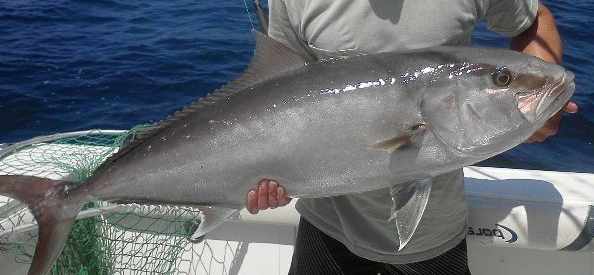 May and June is also when the big boats start targeting yellowfin tuna on the other side of the Gulf Stream.
From Port Canaveral, the boats can run anywhere up to 120 miles to get a shot at these delicious bruisers.
Let's hear it for Sushi....
Till Next Month, Good Fishing & Tight Lines To You All! | |||||

| Link One | Link Two | Link Three | Link Four | Link Five | Unsubscribe to this newsletter |