Your February 2013 Mosquito Lagoon & Indian River Fishing Forecast
Published: Fri, 02/01/13
| Newsletter Issue # 42 Fishing Forecast |
February 1, 2013 | |||||||
Mosquito Lagoon & Indian River Fishing | ||||||||
osquito Lagoon & Indian River So far this year, mid winter sightfishing has been a hit or miss proposition in the Mosquito Lagoon.
The winter winds can turn a potentially great sightfishing day into a day of aimless blind casting or trying to find a sheltered shoreline to fish in the Pole and Troll zones.
But if you luck out and get a calm day, you can pick up some really nice sea trout and redfish on the gin clear flats.
Sightfishing the Mosquito Lagoon and north Indian River for redfish is fabulous when the weather permits and as of this writing, the reds are all over the flats.
When you sight one, a gold ¼ oz Aqua Dream, Johnson's Sprite or Nemire Red Ripper spoon pitched from a 7 ft spinning rod with light line will get
the job done.
January and February are prime months for catching really big gator sea trout in our area.
The secret to successful winter trout fishing is to fish between the cold fronts when they roll through our area.
As the cold weather front drops the water temperatures, the trout will move from the deep holes out onto the grass flats, when the sun warms up the water, to forage for food. The smaller sea trout will school up and can be caught with small jigs, shrimp on popping corks or small topwater lures along the transition edges of the flats where the water drops to 3-6 feet or
more.
The large gator sea trout are roamers and seldom school up. They frequently wind up in extremely shallow water and in
the most unlikely spots.
During February, when water temperatures become comfortable enough for them, the larger gator sea trout can be sight fished on the shallow flats where they can be found hanging around the edges of white sandy potholes in water as shallow as 12 inches.
The best grassflats to fish are those that have deeper channels along their outer edges.
A live grunt or croaker fished under a Cajun Thunder rig is deadly for gator sea trout.
Larger topwater lures, DOA CAL jerkbaits and Aqua Dream spoons fished very slowly will also produce.
The Indian and Banana Rivers, Sebastian and Fort Pierce Inlets and the Mosquito Lagoon flats are all good areas for giant sea trout.
The low, gin clear water makes the fish extremely spooky during the winter months, so stealth and a long casts with light lines are the order of the day.  Wading is a great way to get close to large fish without spooking them, as you can see by the above pic. All the fish were caught with gold spoons while wading a shallow cove in the Indian River.
When the water temperatures drop into the low 50s, it's time to go deep for big sea trout.
Canals, harbors and dredge holes with muddy bottoms will hold a couple of degrees of extra warmth and become points of refuge for large trout.
Working a swim bait, shrimp imitation or a sinking hard bait extremely slow and deep in the water column will work during periods of low light or at night. A freelined finger mullet, grunt or jumbo liive shrimp will also get you a hookup.
Fishing the thousand islands deepwater canals in the Banana River during the first couple of hours of daylight with a jumbo shrimp on a #1 or #2 wire hook under a small float is a deadly method for catching gator sea trout.
Let the shrimp run under docks or to the edge of cover. Don't use swivels, leaders or any other terminal tackle, just tie the hook directly to your line. The shrimp must act totally natural to fool the biggest fish.
___________________________ Sebastian Inlet
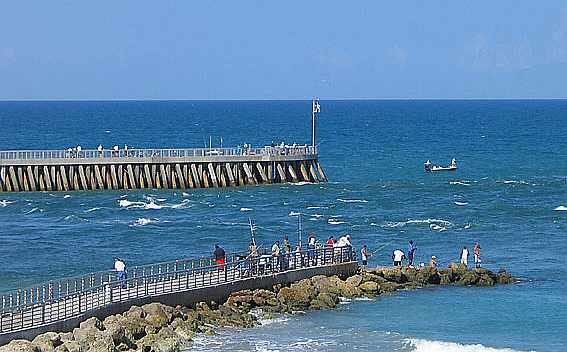 With the February 1st. opening of this year's snook season, crowds of fishermen will be lining the 750 foot north jetty of Sebastian Inlet. With the February 1st. opening of this year's snook season, crowds of fishermen will be lining the 750 foot north jetty of Sebastian Inlet.During outgoing tides; shrimp, crabs and a variety of finfish are pulled though the inlet from the Indian River followed by clean ocean water that flushes out the inlet during the incoming tides.
The majority of bank anglers looking for snook fish from the inlet side, primarily at night, using assorted bucktails, grubs, flair jigs or large diving plugs.
Boaters at night power drift using live baits for snook with good results.
During the day when the snook bite turns on, fishermen use live mojarras, mullet, croakers, pigfish or jumbo shrimp. Savvy local anglers watch the tides for natural baits in the inlet in order to more precisely target what the fish are eating.
Use just enough split shot or a small barrel sinker to drift your bait just off the rocky bottom.
Newcomers to the area will lose a lot of terminal tackle on the rocky bottom until they get the hang of it.
If you fish from a boat, one of the "hotspots" is to anchor just off the tip of the north jetty and fish with live or cut bait.
You can expect to pick up everything from snook, jumbo redfish and black drum to Spanish nmackerel, various typesof snapper, sheepshead, shark, the last of the bluefish and possibly even a tarpon.
The Inlet park is 15 miles south of Melbourne Beach on State Road A1A and if you're interested in fishing the inlet, go to www.sebastianinletdistrict.com for current fishing reports and live web cams.
___________________________ Playalinda Beach
 Playalinda Beach surf fishermen have been catching whiting, pompano, bluefish and occasionally juvenile black drum in the surf. Playalinda Beach surf fishermen have been catching whiting, pompano, bluefish and occasionally juvenile black drum in the surf. With the onset of colder weather, the pompano fishing should be and is already picking up considerably.
Sand fleas, small pieces of fresh shrimp, cut clams and cut mullet have been the most productive baits. Parking Lots #7 thru #9 seem to be the most productive areas. ____________________________
Near Offshore and Offshore
Cold fronts will dictate how good the offshore fishery will be during February.
The main problem for bottom fishermen is getting through the black sea bass and red snapper that are stacked on the reefs.
With Black Sea Bass, Red Snapper, Vermillion Snapper
and Shallow water Groupers closed for seasonal closures and deep water groupers closed beyond 240', there isn't much left to legally take home for a fish dinner. Triggers??
In a month or so as the waters again begin to warm, the Pelagics will begin to show up and we can expect to see more kings, dolphin and cobia.
Right now the calm days between cold fronts are good times to fish for smaller kings in the 70 to 90 foot range southeast of Ponce Inlet and around Pelican Flats outside of the Port
and for tripletail or cobia around the Sargassum weed patches closer to shore.
Until next time,
Tight Lines To All!
| ||||||||

| Link One | Link Two | Link Three | Link Four | Link Five | Unsubscribe to this newsletter |