Your April 2012 Mosquito Lagoon & Indian River Fishing Report
Published: Sun, 04/01/12
| Newsletter Issue # 32 Fishing Forecast |
April 1, 2012 | |
Mosquito Lagoon & Indian River Fishing | ||
Mosquito Lagoon & Indian River Fishing Redfish have been pretty consistent so far this year and should continue thru the month of April. Despite the windy conditions that made sight fishing for redfish unpredictable during March, look for the fishing to improve as we move into April and May. The redfish have broken up into smaller schools of 25-50-100 fish. Finger mullet schools and pin fish are showing up in both of the Lagoon systems, the water temperatures have been consistently in the 70's, and the fish are fat and feeding well. Although top water baits will produce the best fish, most areas have a lot of floating grass on the water that lifted up off the shorelines when the water levels rose. This makes "walking the dog" with a top water bait challenging to say the least. A better lure choice for tailing reds is a 3 or 4 inch DOA CAL or a 3 inch DOA shrimp. Other lures that produce well are Aqua Dream spoons, gold Johnson spoons, Mirrolures and Sebile suspending plugs.  The fallback hot ticket bait of choice has been live finger mullet however, some days the fish prefer only live shrimp. The fallback hot ticket bait of choice has been live finger mullet however, some days the fish prefer only live shrimp. Fly fishermen have been doing well with clouser minnows, spoon flies, worm patterns, deceivers and seaducers. The best time to fish for redfish in the Indian River north of S.R. 528 seems to be during the very early morning hours of the day. Most of the fish that are being caught in this area are by sight casters using Berkley Gulp jerk baits, D.O.A. CAL baits and live shrimp. The majority of fish being caught are at the lower end of the slot, around 23 inches in length. Some bull redfish are also reportedly being caught around the Scottsmoor area of the north Indian River Lagoon. March has provided us with some phenomenal sea trout fishing this year and April should be just as productive if not better. Because of the mild winter, the warm waters have triggered good numbers of finger mullet to move into the shallow flats, the creeks, and the edges of the channels. This annual baitfish migration triggers the big gator trout to feed aggressively. Sea trout in the Indian River Lagoon system start to spawn when the temperatures remain relatively constant and there are no major temperature drops. When you can find cooler waters in the Mosquito Lagoon and Indian River, you will also find some of the best sea trout fishing in the world. Since the constitutional net ban was implemented in the 1990's, the sea trout fishing has rebounded and today anglers are catching them by the boat loads. The smaller sea trout are being caught on the transition edges of the flats where the water drops to 3-6 feet or more. Small jigs, live shrimp on Cajun Thunder rigs or popping corks and small top water lures like the tiny torpedo or Zara Spook Jr. will get you a hook up. The larger "gator" sea trout are being caught in the shallower water following the baitfish as the water temperatures become comfortable enough. 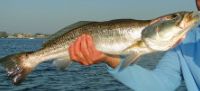 March and April are considered the best months of the year to fish for "Gator" spotted sea trout in East Central Florida. The biggest problem anglers have is dealing with are cold fronts and windy conditions that can often close down fishing opportunities. As you know from my website, larger sea trout will often be out in numbers and eager to feed between and before the fronts. Big gator trout are usually hungry for any lure or bait when delicately presented to them from a distance, but they are easily spooked. That's how they get that big. Clear waters and skies make it easier to spook fish and a big "gator" trout will quickly leave the flats when a fisherman gets too close; so make long casts with either live baits or artificials on light lines and be patient. Wade fishermen in April always take a good percentage of "gator" sea trout using top water plugs in the morning hours along the western flats of the Indian River, between Mims and Scottsmoor. The Mosquito Lagoon and Indian River area is famous for it's sea trout spawn which produces some of the finest "gator" sea trout fishing in the United States. Near Offshore Fishing April and early May are the best months to fish for Dolphin out of Port Canaveral however, off shore of Cape Canaveral, fishermen hunt Dolphin (Mahi Mahi or Dorado) all year round. Canaveral's dolphin run usually marks the end of the annual cobia run, but there are always a good number of stragglers around to keep you busy when you're after king mackerel or some of the other offshore species. 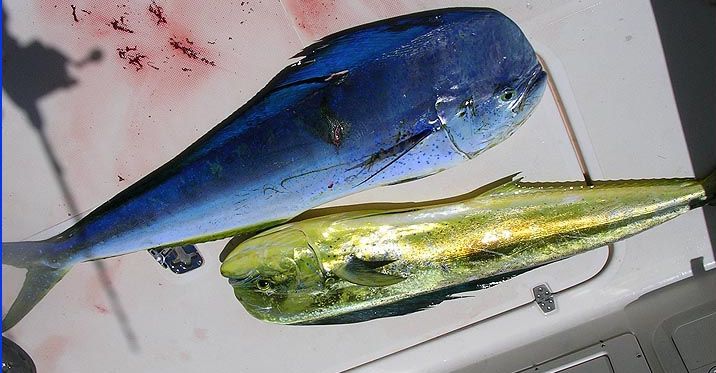 In the spring and summer the bite goes off When the Dolphin migrate past Cocoa Beach heading north. In the spring and summer the bite goes off When the Dolphin migrate past Cocoa Beach heading north. They travel the western wall and inside of the Gulf Stream chasing the massive schools of off shore bait fish. You can find them from the reef's and wrecks out to more than 40 miles, with the higher concentrations of fish at about 20 miles. The bigger Bull Dolphin and Cows are caught in the spring and early summer and often swim alone or in pairs with other larger fish. The smaller fish almost always travel in schools. To catch dolphin, troll with a spread of rigged ballyhoo until you find fish. Then switch baits and use jigs on light spinning outfits. Always keep at least one hooked fish in the water to keep the school near your boat. For the past few weeks, several species of fish including cobia, dolphin and kingfish have been caught offshore and around Port Canaveral at the jetties. The cobia in particular have been feeding on almost anything that swims within their striking distance. Large live shrimp, eels, live crab, live finger mullet, bright colored buck tail jigs and bucktails with plastic or gulp trailers are all producing well for these tasty hard fighting fish. The cobia are running anywhere from 36 to 45 inches and are being caught mostly along the Port Canaveral buoy line and 8-A reef.  Along the jetties and the Canaveral Locks, the Sheepshead have also been pretty active. Along the jetties and the Canaveral Locks, the Sheepshead have also been pretty active. The best time to catch them is during an outgoing tide, preferably during the last few hours of daylight. Fiddler crabs, pieces of clam and shrimp rigged on small jig heads are the baits of choice for these "convict fish". The majority of fish that are being caught are measuring in the 15 to 18 inch range. Just outside of Port Canaveral, tripletail are also being caught around the buoy line by anglers using live shrimp and jigs.
Target floating debris, seaweed or any other floating object for these tasty fish.
_________________________
Playalinda Beach  Surf fishermen will find whiting, bluefish, some Spanish mackerel and a few pompano in the surf during April. Surf fishermen will find whiting, bluefish, some Spanish mackerel and a few pompano in the surf during April. Right now the beaches are holding bluefish, whiting, and some pompano in the surf.
Surf fishing around Playalinda Beach has been sporadic during March. The windy conditions have made surf fishing challenging however, as spring conditions finalize and the baitfish migration continues, the fishing should get better. Expect more windy days into April. If you want to fish the Canaveral National Seashore at Playalinda Beach, start fishing at parking lot#8 across from Eddy Creek and move on to #10 until you find fish.
April can be as windy as March, so choose your fishing days wisely.
Playalinda Beach remains relatively deserted throughout the week and fills up over the weekends. Till next time,
Tight Lines To You All! | ||

| Link One | Link Two | Link Three | Link Four | Link Five | Unsubscribe to this newsletter |