Your June 2011 Mosquito Lagoon & Indian River Fishing Report
Published: Wed, 06/01/11
| Newsletter Issue # 22 Fishing Forecast |
June1, 2011 | |||||||
Mosquito Lagoon & Indian River Fishing | ||||||||
East Central Florida anglers know that from mid May through the end of June it's prime time for big gator seatrout on the Mosquito Lagoon and Indian River flats.
The big egg laden females zero in and target the abundant schools of finger mullet which is their primary forage throughout the Indian River Lagoon system during this time. If you're a late sleeper, you can forget about catching a trophy seatrout. You need to start early and be on the water fishing around a school of baitfish before daylight. The morning feeding frenzy usually dies down by about 9:00 a.m. so you can always catch up on your sleep after the morning sun comes up and starts penetrating the shallows.
Topwater plugs like the Zara Spook, SkitterWalk, MirrorLure and Chug Bug worked in a slow zig zag "walk the dog" presentation will almost always produce slamming strikes when a seatrout detects it.
The slow sloshing action coupled with the internal rattle of the lure will usually grab the attention of these early morning predators. The idea is to make the surface plug mimic an injured mullet that has strayed away from the school. Schools of mullet gather in shallow areas seeking protection from predators. Shallow flats, the submerged spoil banks that parallel the Intracoastal Waterway channel and several shallow bars north of the NASA causeway are prime areas in the Indian River where these mullet schools gather to avoid predators. The entire eastern shoreline of the Indian River just south of Titusville and north of the NASA Causeway also provides prime bottom habitat conditions for gator seatrout. This area, as well as the Mosquito Lagoon, remains undeveloped because of the Kennedy Space Center and the Merritt Island National Wildlife Refuge.
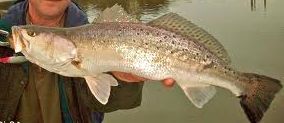 The biggest seatrout station themselves in 2 1/2 to 4 foot depths just off the bars where they lie in wait to ambush the schools of finger mullet. The biggest seatrout station themselves in 2 1/2 to 4 foot depths just off the bars where they lie in wait to ambush the schools of finger mullet.Here they leasurely move in to pick off stragglers from the schools.
These areas are where you need to target to intercept big fish.
Remember, gator seatrout are extremely wary fish. That's how they live to grow that big. Gator seatrout also have keen eyesight and are in tune with their environment. They are extremely sensitive to vibrations. A dropped fishing lure on the deck, water lapping against the hull of your boat or the sound of an electric motor will shut down the bite in a heartbeat. They will spot a high profile caster on a poling platform long before you spot them, so long casts are the order of the day if you insist on fishing from a boat. The most productive method of fishing for large female seatrout is to put down your power pole and wade the edges of the bars and spoil banks, or to fish from a kayak or canoe. The closest boat access to the submerged spoil bars and banks of the NASA Causeway are at Port St. John on U.S.1, Parrish Park, just east of the new Max Brewer Causeway bridge and the Kennedy Point ramp, just south of Hwy 50 on U.S.1. The shallow flats north of Titusville on the west side of the river can be accessed via the Mims boat ramp at 2010 Jones Ave. or the Scottsmoor Landing at the end of Huntington Ave. Fishing the edges of these grass flats has produced many 9 pound plus gator seatrout. Sebastian Inlet is still hot for snook with some tarpon still in the river. It doesn't matter if you fish from your boat, the catwalk or on the jetties during June, if you drift a live bait with the current you will pick up snook.
Jumbo shrimp, live mullet and croaker are still your best bet. Small jigs sweetened with a piece of shrimp are a close second choice.
Tarpon outside of Sebastian Inlet in the 100 pound plus range, kingfish, dolphin, bonito, cobia and Spanish mackerel are also on the agenda offshore.
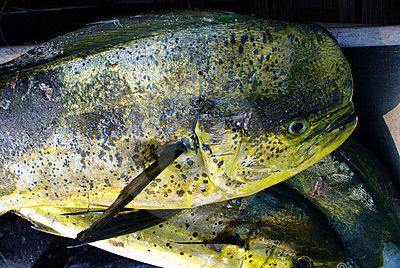 Some really nice bull dolphin in the over 20 pound category are being taken with trolled skirted ballyhoo rigs in 250 foot depths.
Playalinda Beach and South
 Bait up your rig with either a small piece of peeled shrimp or a sand flea and flip a cast out into the first trough. At Playalinda Beach at the Canaveral National Seashore and the beaches from Melbourne south to Sebastian, the beaches slope quickly and a light tackle outfit will get you more bites and fish than heavy surf tackle will. Right now the whiting are in their pre-spawning feeding mode and are thick along the beaches in some areas. When you do find a school, you can often pick up one of these tasty fish on every cast. St. Johns River
The 75 mile stretch of the Central St. Johns River from Lake Harney, north to Lake George produces bass fishing that is next to none in terms of the sheer numbers of Bass and Trophy Bass.
This stretch of the river gets little fishing pressure because of the speed limits and idle zones that are through out this part of the river. The 25 mph boat speed limits and many long idle zones are not very conducive to bass tournaments so many bass fishermen have the river to themselves. The shad run that starts in the early spring usually winds down during the early summer months. Bass during this period will stage on the main river points, shell beds or sand bars to ambush the small 3" to 5" shad that are heading north to the Atlantic Ocean in Jacksonville. You can easily spot these fish busting schools of shad on most of the main river points and you can catch them on soft jerk baits or top water propeller baits. You can get a bite almost every cast when you pitch a lure into the feeding frenzy. If you prefer live bait, just cast net some shad and free line them into the schooling bass. During the summer months after the shad run is over, the bass will start to feed on the natural river forage and can be caught on wild river shiners around the Lilly pad fields. The really big fish will be feeding on spawning pan fish, frogs and large river shiners. A 6 or 8 inch worm rigged with a 1/4 oz. rattle weight flipped into the pads can be deadly as can pulling a soft plastic frog over the pads. This technique is great for locating trophy size fish. 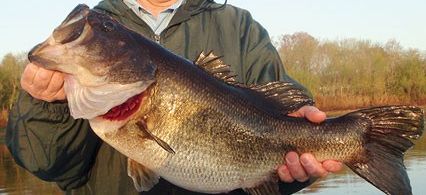 If you're a bass fanatic, this coming month is a good bet to get yourself a 10 pound plus bass in this stretch of the St. Johns. ________________________ Near Offshore Fishing
Outside of Port Canaveral and along the beaches you can expect to see a lot of King Mackerel in the 15 to 20 pound range. They will be targeting the schools of threadfin and will be in 12 to 18 foot depths out to 30 to 40 feet of water.
June is also a peak month for Bull Dolphin outside of Port Canaveral and Sebastian Inlet. The weed lines and rips are key areas to target in depths of at least 250 feet. 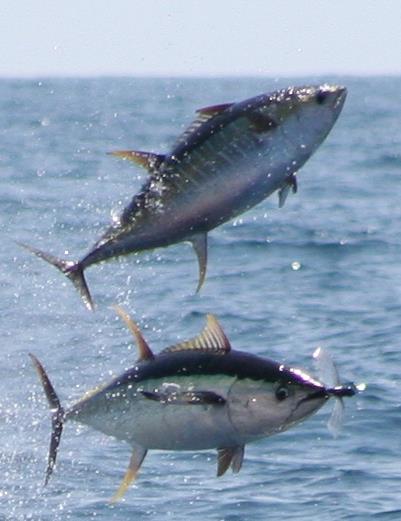 Offshore fishing on the far side of the Gulf Stream is where the big boats go in May and June to target big yellowfin tuna.
One way runs of 100 to 120 miles are not out of the ordinary to target these fish on the "other side" of the Gulf Stream but when you find a school the action is just phenomenal.
Lets hear it for Sushi!
Till Next Month, Good Fishing & Tight Lines To You All! | ||||||||

| Link One | Link Two | Link Three | Link Four | Link Five | Unsubscribe to this newsletter |