Your September 2014 Mosquito Lagoon & Indian River Fishing Report
Published: Mon, 09/01/14
| Newsletter Issue # 61 Fishing Forecast |
September 1, 2014 | ||||
Mosquito Lagoon & Indian River Fishing | |||||
Mosquito Lagoon and Indian River
Labor day marks the official end of summer, the re-opening of Snook season, and the heralding in of the redfish spawn in all our lagoon systems on the Space Coast.
The resident Redfish population in the Mosquito Lagoon and Indian River Lagoon systems is special and unique in that they do not join up with the massive open water schools typically found in the inlets and passes. The waters north of Grant in the Indian river and south of Georges Bank in the Mosquito Lagoon have no measurable tidal movement and although many other parts of the country have good populations of Redfish, our unique resident population of inshore breeders is virtually landlocked.
Because our Redfish live, spawn and die in a relatively confined area, they have become extremely wary to the increased fishing pressure and in many areas are savvy to most lures being tossed to them.
With the exception of the fall spawning event, the large schools of Redfish that we used to see packed together in tight balls for months on end are no longer a common sight.
Because of increased fishing pressure, the behavior patterns exhibited by the fish have also changed.
The good news is that breeder Redfish become voracious feeders during the spawn and are easy to catch. 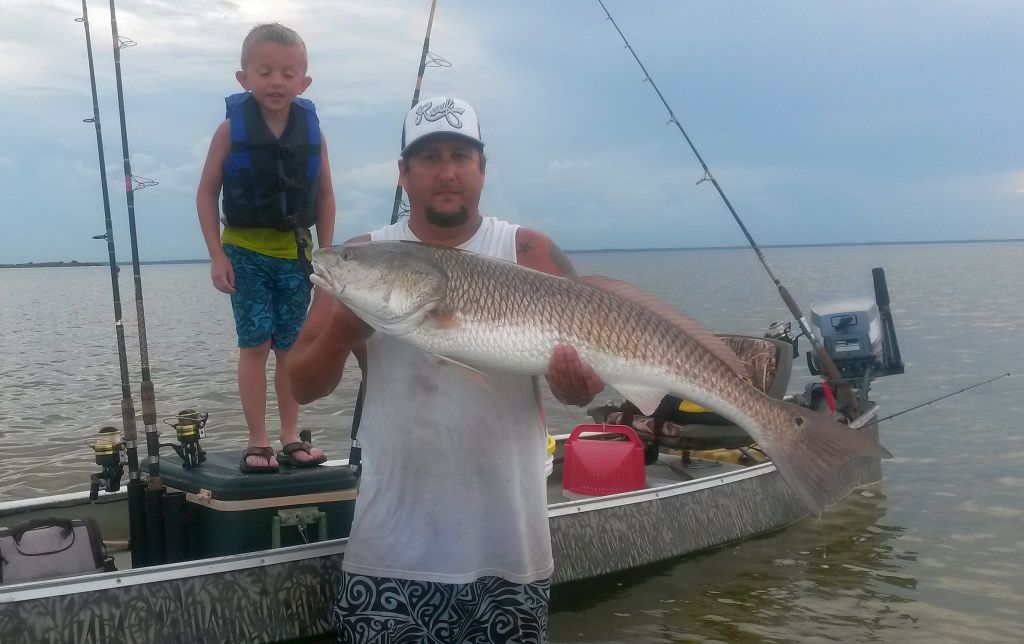 Although the windy conditions we endured most of this past month often made fishing a challenge, getting out on the water early and late is still the best all around strategy. Look for slot Redfish and sea trout to be
shadowing schools of finger mullet working south through the estuaries.
The larger redfish and sea trout will be staging along the deeper ambush
locations like drop-offs, creek mouths, bridges, causeways, and points were
schooling baitfish are forced to leave the safety of the shallow flats.
In the Mosquito Lagoon, the area from Widgeon Bay up to around Tiger Shoal has been good for slot size reds.
The best way to latch on to a 40 inch plus breeder "bull redfish" is to toss a large cut bait into their path but not necessarily in front of their nose.
Because tons of mullet have already moved into the Lagoons, (making for an excellent early morning topwater bite) the two top baits to use will be mullet and Ladyfish. The larger (striped) black mullet is preferred by most fishermen for use as a cut bait because of it's pungent aroma, while the smaller (narrower) silver mullet for live bait fishing. The silver mullet seldom exceeds 10 inches in length, which makes it an ideal live bait. The larger black mullet is broader and more hardy when fished as a live bait and although they run 10 to 15 inches, they make a great live bait for Redfish in the over 40" category. Another outstanding bait for bull Redfish is a ladyfish or a large black mullet cut in half. The head and middle section with the guts intact are the best parts. You can toss what is left back into the water for chum. Use heavy bait casting rods, or 20 or 30 pound class spinning rods to cast these heavy baits to breeding Redfish. Because breeding activity takes place in the warmest months, oxygen levels are low and you want to get your fish in and released as quickly as possible to reduce stress. The above spinning rig with 30lb Power Pro main line tied to a 3 foot leader of 40/50lb fluorocarbon and a 6/0 or 7/0 VMC circle hook is all you need to get a big breeder Redfish in quickly. 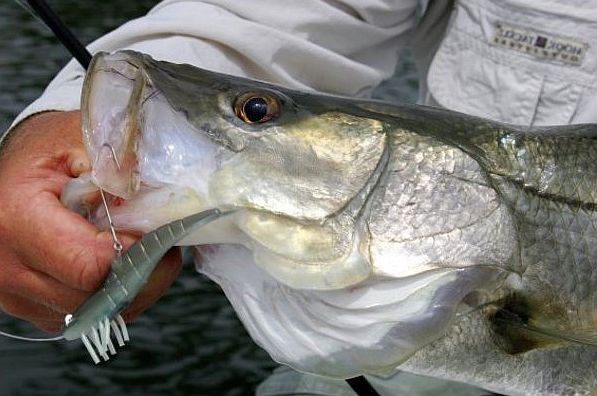 Snook season reopens September 1st and the jetties and deep water basins inside Port Canaveral usually hold a good population of these prized gamefish. Snook season reopens September 1st and the jetties and deep water basins inside Port Canaveral usually hold a good population of these prized gamefish. Fish the dock pilings, near piers and jetties during the dusk and low light periods with live mullet, croaker, or pogies on a sliding sinker rig with a 4/0 to 6/0 sized VMC 7385 circle hook and you should be in business. The slot size is 28" - 32" with a one fish per day limit. The jetties will also produce mangrove snapper, Ladyfish, flounder, Redfish, bluefish, Jack Crevalle and even shark this time of the year. You never know what a live bait will entice. For anglers who enjoy tossing artificial baits, try using lipped diving plugs for Snook. Around the jetties, anything that resembles a live mullet will work however, I'm partial to MirrorLures, the Rapala BX series, and Rapala X-Raps. Snook are also found in many areas of the Mosquito Lagoon and Indian River. They tend to hang very close to the shoreline mangrove roots, sea walls, around lighted docks and along ambush points at the bridges, especially during low light conditions and in the evening hours. Large live shrimp, croaker, mullet or a pinfish will hook you up.
Sea trout will also be very accommodating during September. Fish the bait schools! The larger fish will be hitting topwater baits in the early morning hours, during low light periods and at dusk. Fishing during a thunderstorm also produces some very nice fish, but watch out for lightning. In addition to large sea trout, the topwater bite will also attract Redfish, Ladyfish, and an occasional Jack Crevalle. All love to blast a topwater Zara Spook, MirroLure, Top Dog, Top Pup, Chug Bug or SkitterWalk. When the topwater bite slows down, try switching to a D.O.A. CAL soft plastic jerkbait or a Z-Man Paddlerz.
Use light colors during high visibility high light conditions and dark colors during low visibility low light conditions. Don't be afraid to use odd colors. I recently was about to give up on a days fishing but as a last resort, I decided to switch to a pink colored Hogy that I had never used. The odd color worked and I picked up a nice oversize redfish along a drop-off before heading home. You never know!
I have become a firm believer in the use of Pro-Cure Super Gel _______________________
Surf Fishing Silver mullet, pogies, Snook, tarpon, bluefish, Spanish mackerel, jack crevelle and other tropical fish species migrate north up the Atlantic coast in the spring, spend their summers in the rich estuarine waters of the eastern seaboard fattening up and spawning all summer long, and then school up for their mass migration south in the fall. This makes September a prime month for surf fishing East Central Florida's beaches.
The Snook run has already started along our beaches and by the time you read this should be in full swing.
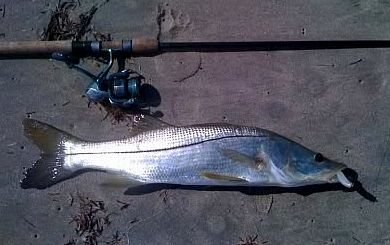 With the arrival of finger mullet in the surf it is important to "match the hatch" to score so use a freshly netted mullet for bait or an artificial bait that mimics a mullet. The Rapala X-Rap in silver and olive green
colors or DOA's Shallow Running Baitbuster, 5.5" Big Fish Lure,
Swimming Mullet or Terror Eyes all work well in the surf for Snook.
Since Snook are primarily nocturnal feeders, fishing at first light and at dusk between the beach and the first sandbar will be your best bet. Snook will come close to shore to ambush baitfish and are frequently found in the closest troughs and washes of shore breaks.
This makes using a fast action medium heavy spinning outfit with a 4000 series reel a necessity.
Load the reel with 20 or 30 pound braid and a 40 or 50 pound fluorocarbon shock leader to minimize break offs. Like fishing for whiting, it is seldom necessary to cast past the first sandbar to catch Snook.
Surf fishermen will also hook up with shark, bluefish and Spanish mackerel during the fall baitfish run so long shank hooks, heavy fluorocarbon leaders and even wire leaders are a good idea.
The beaches around Patrick AFB are a great area to fish for Snook, shark and even near shore tarpon. For tarpon along the beaches, rig up with a heavier spinning outfit and an 8/0 or 9/0 VMC circle hook baited with a live menhaden or mullet.
_______________________
Near Offshore Fishing Anglers out of Ponce, Sebastion, and Port Canaveral are targeting Wahoo by trolling purple or black skirted ballyhoo or high speed lures on the natural ledges in 180 to 250 feet of water. 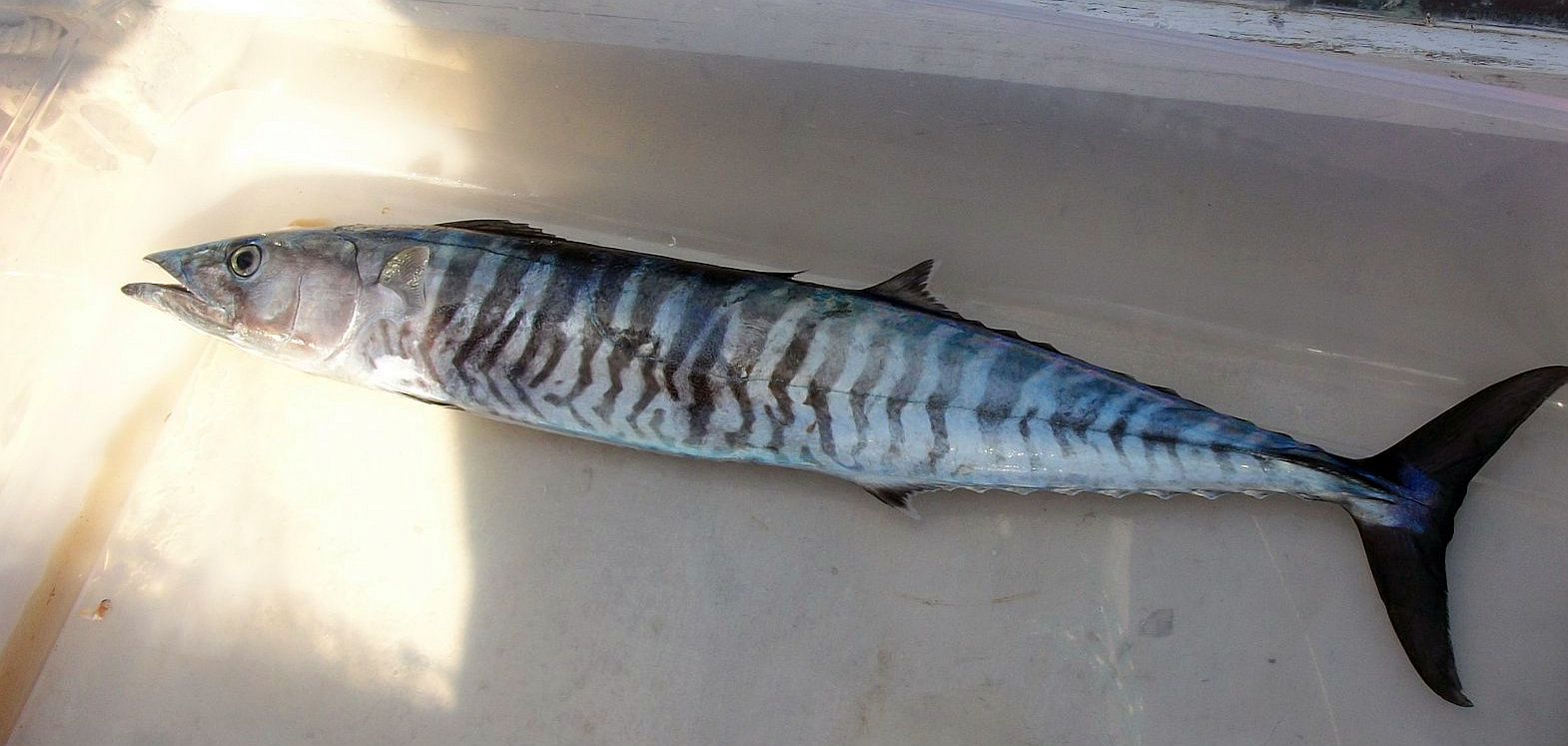 The average size Wahoo being caught is 15 to 25 poounds with some in the 40 pound plus range. King mackerel are holding on the 60 to 90 foot reefs in clean water. Slow troll live mullet or pogies on a wire stinger rig to hook up with fish averaging 15 to 20 pounds and an occasional fish up to 30 pounds. Tarpon are all up and down our beaches right now and in the deeper waters of all our lagoons. The deeper sections of Tiger Basin in the Mosquito Lagoon has been productive, especially during calm days when you can see the fish suspending or rolling. Look for river tarpon in 5 to 6 feet of water and pitch a pigfish or pinfish to them for a hookup. In the Indian River Lagoon, the tarpon are keying in on white plastic baits or flies.
The average size for our lagoon tarpon is around 15 to 40 pounds with an occasional 70 pounder. The average size beach tarpon has been from 70 to 100 pounds. Jack Crevalle are also hot right now in Ponce, Sebastian and Canaveral Inlets with fish being caught in the 5 to 15 pound range. Fish in the 30 pound range are also being caught just outside of the inlets and in between the beaches. Fish your lures as fast as you can crank them to catch these fish. Like Wahjook, Jacks love fast baits. The Rapala XRap minnows and the new Williamson Surface Pro Poppers have been the best producers for the past couple of weeks. Haulover Canal
Boat fishermen in Haulover Canal are still making good catches of black drum, redfish and mangrove snapper.
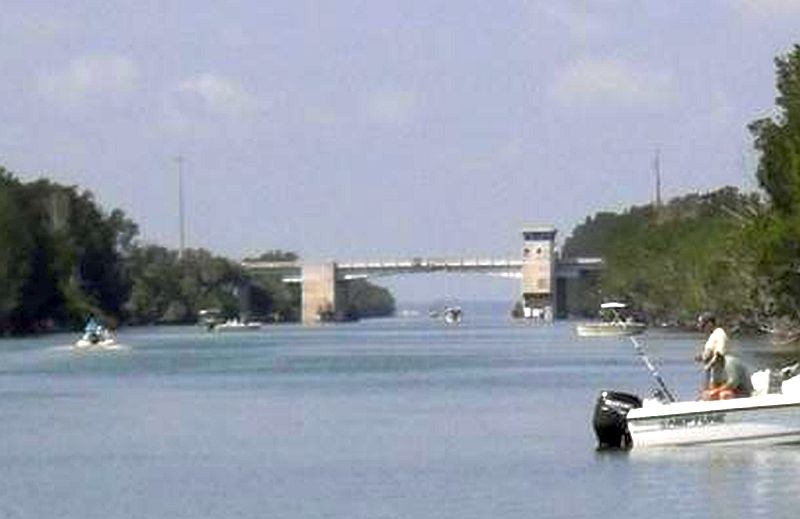 Most of the deeper waters of our area bridges and causeways still hold good numbers of black drum, as do the deeper sections of Haulover Canal.
Fish fresh sections of blue crab, cut clams or live shrimp on a standard sliding sinker rig for these fish.
The average size Black Drum is between 5 and 20 pounds.
Breeder redfish are also passing through Haulover Canal and are being caught on a variety of live and dead baits.
Live pinfish, grunt, half of a ladyfish or mullet, or a half of a fresh blue crab on a 6/0 or 7/0 vmc circle hook
______________________
St. Johns River
The St Johns River in East Central Florida is where you need to be this month if you're a bass fisherman.
Small boat fisherman willing to deal with a lot of shoaling, will be targeting the deep water bends where bass hole up like cord wood during low water periods during the summer heat.
The deep river bends that drop from 8 to 10 feet with some as deep as 20 feet are where the
The area south of SR 46 on Hatbill Park Road to Puzzle Lake and around Hatbill Park five miles south of SR 46 on Hatbill Park Road are good areas to fish .
Good ramps are available at the SR 46 bridge and at Hatbill.
A Gheenoe, kayak, canoe or airboat will minimize the effort needed to get to these spots but you can count on big bass being in these holes.
A 6 inch Texas rigged black and blue plastic worm on a bait caster with 20 or 30 pound line will get the job done. Fish the worm like you would in winter; very very slow. Almost dead on the bottom.
Because of the northern flow of the St. Johns, deeper bends can also be found north and south of SR 50 and farther downstream between the old Marina Isle area and Lake Harney just east of Sanford.
There is a single lane launch ramp just west of the river at SR 50. The closest ramp for the Marina Isle Lake Harney area is at Mullet Lake Park north of SR 50. The ramp for areas south of the SR 46 Bridge is at C.S. Lee Park at the bridge.
If you want to cross lake Cone, you will find some exceptionally deep bends up to 20 feet deep north of SR 50 but with the low water levels you need a non-conventional boat. A better bet is to put in at Hatbill Park and make the 4 mile run south.
The simplest routes are the three miles between SR 46 and Puzzle Lake; the first two to three miles south of SR 50; and several miles in either direction out of Mullet Lake Park.
Regardless of how you get there, the bass are big and easy to catch right now.
Till Next Month, Good Fishing & Tight Lines To You All! | |||||

| Link One | Link Two | Link Three | Link Four | Link Five | Unsubscribe to this newsletter |