Your February 2011 Mosquito Lagoon & Indian River Fishing Report
Published: Tue, 02/01/11
| Newsletter Issue #18 Fishing Forecast |
February 1, 2011 | |
Mosquito Lagoon & Indian River Fishing | ||
Mosquito Lagoon & Indian River Lagoon Fishing
for redfish, black drum and sea trout will continue to be good to excellent throughout the month of February. The falling temperatures and water levels have set the stage for some of the best sight fishing you will experience all year in both Lagoons, especially when the wind settles down a bit. Large schools of redfish, black drum and sea trout in both Lagoons are feeding heavily trying to build up their body mass to survive the winter. The fish are gorging on shrimp, crabs and bait fish when they can be found.
Many of the tropical species like snook, tarpon, jacks and mullet have gone farther
south for the winter or migrated upstream into the creeks and rivers
looking for warmer waters on muddy bottoms. As water temperatures continue to drop, the metabolism of most fish species slows down, so it's important for you to target warmer water locations and to slow down your bait
presentation.
As the sun begins to warm the water on sunnier days, target the sandy potholes within the grass flats where both redfish and sea trout can be found seeking the
sun's warmth of the reflection on the sand.
Target deeper locations on colder days where the water is a few degrees warmer. Concrete
structures hold heat longer and seawalls, ramps and bridges, and
deeper holes with black mucky bottoms that absorb the sun's heat are good locations to target. Later in the day as the flats heat up, the feeding and tailing activities of
redfish and black drum become more pronounced.
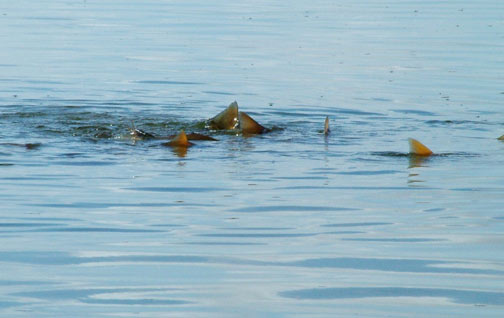 With this in mind, early morning pre dawn starts aren't really necessary in February. Instead, go have yourself another cup of java or catch up on your sleep time.
The feeding patterns of most species change as
their available forage changes.
Because the water levels have come up a little from last week's cold front, good numbers of big sea trout are coming up from their deep murky bottom locations next to the shallow flats to ambush shrimp or bait fish. The professional guides and fishermen I spoke with all tell me that they are having their best luck using night glow or light colored DOA shrimp, or DOA CAL Jerkbaits fished very slowly. A couple of guides reported catching 50 to 60 fish per trip and they expect this to continue throughout the month of February.
Extremely slow retrieves are mandatory this time of year if you want to be successful fishing in cold water conditions. The slower the better. Remember that wintertime crystal clear water conditions require lighter lines, fluorocarbon leaders and long casts if you want to keep from spooking the fish.
_______________________
Banana River No Motor Zone
 Nothing beats the Banana River Lagoon No-Motor Zone in the winter for fly fishing for large black drum and redfish on the flats. Nothing beats the Banana River Lagoon No-Motor Zone in the winter for fly fishing for large black drum and redfish on the flats. In an effort to protect endangered species, the government set aside 10,500 acres of the Merritt Island National Wildlife Refuge as a manatee refuge. They established a marine sanctuary that is only accessible by paddle or sail; the use of any motorized vessel of any type is prohibited.
Because of this, there is very little angling pressure in the pristine sea grass beds and undeveloped shoreline of the banana river no motor zone.
It is probably the only place where you can see 40 pound plus black drum tailing on the flats eager to eat a well presented crab fly.
Few things in life will get your heart pumping like the sight of a huge redfish or black drum tailing in shallow water, taking your bait and towing your kayak or canoe around.
 Haulover Canal will continue to be a hotspot for over sized bull reds this coming month. The fish congregate in the canal and use it as a respite during cold water conditions. Haulover Canal will continue to be a hotspot for over sized bull reds this coming month. The fish congregate in the canal and use it as a respite during cold water conditions.Redfish and black drum can be caught using blue crabs, cut ladyfish, pigfish, grunt, live pinfish or mullet fished just off the bottom.
Haulover Canal is always good fishing, but February can be an exceptional month. Port Canaveral fishing for northern weakfish should be peaking in February. Northern Weakfish are similar in appearance to spotted sea trout. The main exception is the small spots arranged in diagonal lines on their bodies plus the fact that they only average 2 to 3 pounds. The Florida record taken in December of 1987 was 10 pounds and was landed at Port Canaveral. 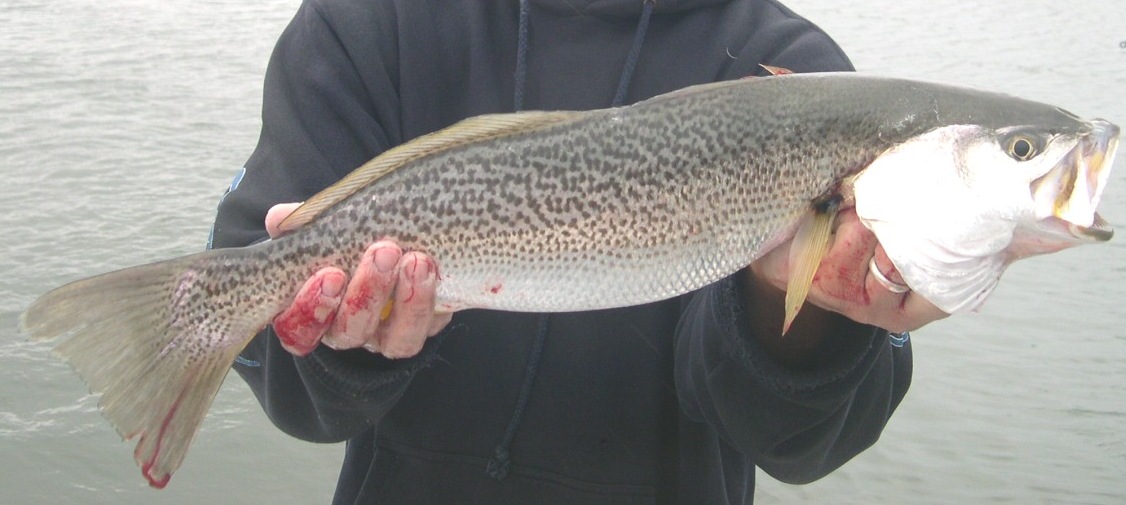 They can be easily caught using ultralight tackle on small 1/4 oz. yellow jigs and fluorocarbon leaders. Trim the tails of the jig close to the bend of the hook to eliminate short strikes. Locating schools in the 20 to 40 foot depths is easy with a depth finder and once located just park on top of the school and deep jig. You can fill the four fish, 12" min size limit in no time at all. You can also expect to pick up some smaller silver trout, Spanish mackerel, bluefish, pompano, mutton snapper and sometimes even small black groupers. Right now the only place you can fish for northern weakfish by boat in the port is in the middle turning basin. The only shoreline access is along the south shore. If using a GPS use these coordinates: 28-24.4556'N and 80-36.3016'W. This puts you on a drop off just off the north dock where you can usually find good numbers of fish. Weakfish are stubborn fighters and great eating. Because of the thin membrane around their mouths, you will lose quite a few fish if your drag isn't adjusted properly. That's why they are called weakfish. You can launch your boat at either Freddie Patrick Park adjacent to Sunrise Marina or at Port's End Park next to Scorpions New Port Marina. Port's End Park is also good access for bank fishermen. You need to pay attention to the security regs at the port. They are strictly enforced with no exceptions. Small craft boaters venturing out to the buoy lines at Port Canaveral will find tripletail a solid bet this February. Look along the buoys, seaweed and any floating debris to locate these tasty fish. Catch them with light tackle and DOA shrimp, small jigs or freelined live shrimp. Tripletail are great fighters and superb on the dinner table. _________________________
Playalinda Beach surf fishermen will find pompano peaking this February. The best numbers  will be found along the Canaveral National Seashore at Playalinda Beach (try lots #8 thru #11), and the beaches from Melbourne Beach south to Sebastian Inlet. will be found along the Canaveral National Seashore at Playalinda Beach (try lots #8 thru #11), and the beaches from Melbourne Beach south to Sebastian Inlet.The usual smorgasbord of bluefish, mackerel, whiting, etc. will also be available to surf fishermen along the semi deserted Playalinda Beaches.
Use short fluorocarbon leaders to keep the baits on bottom. Tight Lines To You All! | ||

| Link One | Link Two | Link Three | Link Four | Link Five | Unsubscribe to this newsletter |