Your September 2010 Mosquito Lagoon & Indian River Fishing Report
Published: Wed, 09/01/10
| Newsletter Issue #13 Fishing Forecast |
September 1, 2010 | |||||||
Mosquito Lagoon & Indian River Fishing | ||||||||
nshore Forecast Mosquito Lagoon & Indian & River Lagoon Fishing
Early morning and late evening fishing will pay off when targeting schools of redfish in the southern regions of the Mosquito Lagoon this month.
As usual, quiet approaches will pick up many more of the slot size reds that have been hammered throughout the summer months by fishermen using artificials.
Live baits such a finger mullet, pigfish or grunt, pinfish, and shrimp rigged with a circle hook and free lined or suspended under a Cajun Thunder rig, will pick up both reds and large trout in water less than two feet deep. Fish the pot holes and hang on.
Late August and September is when the big breeder
redfish start to group up on and around both of
the lagoons. September is probably your best chance throughout the year to catch a GIANT redfish
with some fish exceeding forty pounds and an occasional fifty pounder, if you hold your nose right.
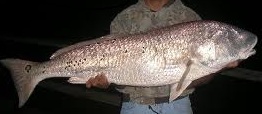 Watching the redfish school up over the
weeks in August for their annual spawn is an exciting event for anglers in the Mosquito Lagoon. Watching the redfish school up over the
weeks in August for their annual spawn is an exciting event for anglers in the Mosquito Lagoon. Seeing these large
redfish staging in their spawning areas and watching the numbers of fish
in each pod grow daily into large schools aggregates, is an exciting experience.
Any angler coming into our area in late August will enjoy catching these large breeding reds well into September. I personally favor top water plugs for trout and redfish and with the fall mullet run coming, you can expect some great top water action throughout the entire month of September.
Artificial lures such as MirrorOlure's MirrOminnow, Storm's Chug Bug, and the proven SkitterWalk are the preferred choices for very early morning and late evening or night fishing, on both the Mosquito Lagoon and Indian River Lagoons. The trout fishing in the Mosquito Lagoon has been killer during the past month and is expected to get even better during September, especially for the bigger fish.
The eastern shoreline of the Indian River north of S.R. 520 has been yielding sea trout that are averaging 17 inches, with larger trout occasionally being caught. Most of these fish are being caught near schools of baitfish under a bright moon at night.
Again, use small topwater lures such as Storm's 1⁄4 ounce Rattlin' Chug Bug and fish it slow on light tackle. The redfish have not been able to resist Nemire's 1/4 oz. Red Ripper Gold Spoon fished near potholes and channel drop offs. A seven foot medium action spinning reel combo, equipped with 10 lb test braided line and 12 inches of 12 lb test mono leader, is enough to bring these fish to the boat.
The western shoreline of the Indian River north of Titusville, in the area of the Mims small boat launch, has been yielding quite a few smaller 18 - 27 inch slot sized redfish, in addition to the massing 20 to 40 fish schools of bull redfish in the over 40" size range. Again, this fishing should continue throughout the month of September.
I had been having problems with my topwater fishing this past month; but after slowing down my lure presentation, I started getting more hits and bigger fish. A guide friend of mine keeps telling me to "slow it down to a crawl" when topwater fishing, but I still have a tendency to fish fast to cover more water.
Big trout and especially big redfish require a really slow lure presentation. The really big "bull" redfish don't like to waste energy chasing down their food. They much prefer having it served to them slowly, or sitting on the bottom. Nothing beats a fresh cut chunk of ladyfish on the bottom, if you want to catch a really big "bull" redfish.  Kayakers have been enjoying some great shallow water fishing in the mudflats around the Peacocks Pocket area for large black drum, redfish and sea trout. The kayaks can get in really shallow where most of the other flats boats don't venture. At dusk you can actually hear the fish drumming in the water as they approach you. Kayakers have been enjoying some great shallow water fishing in the mudflats around the Peacocks Pocket area for large black drum, redfish and sea trout. The kayaks can get in really shallow where most of the other flats boats don't venture. At dusk you can actually hear the fish drumming in the water as they approach you.Gold Crocodile or Johnson Sprite spoons, DOA Terror Eye baits in rootbeer, Bass Assassin or DOA jerk baits, DOA shrimp in gold or rootbeer, and of course top water Zara Spooks or Skitter Walks in gold or black and silver colors all work well on light tackle. Haulover Canal is always good fishing, but it will be a hotspot throughout the month of  September. Fresh chunks of cut mullet and ladyfish, as well as blue crabs can be used throughout the Haulover Canal for large bull reds and black drum this month. Fish measuring up to 40 inches or more have never been able to resist these baits when fished on the bottom. September. Fresh chunks of cut mullet and ladyfish, as well as blue crabs can be used throughout the Haulover Canal for large bull reds and black drum this month. Fish measuring up to 40 inches or more have never been able to resist these baits when fished on the bottom. Bull redfish, huge black drum, snook, tarpon, and other gamefish use the canal as a marine Interstate Highway between the Mosquito Lagoon and the north Indian River. The Bananna River sea trout bite on the west side of the thousand islands around Coco Beach, is still phenomenal and should continue through the month of September. Skitter walks, XRaps, and DOA shrimp under Cajun Thunder rigs are still producing early and late. At Port Canaveral, the mangrove snapper have aggressively been feeding on live shrimp during the early morning hours until mid-morning. The average length of these fish has been about thirteen inches. Look for tidal flow near structure when targeting these fish.  Many snook have also been feeding on live mullet near the jetties and along the beach near schools of bait fish. Snook measuring up to 33 inches have not been able to resist a free lined pinfish rigged on a circle hook. Many snook have also been feeding on live mullet near the jetties and along the beach near schools of bait fish. Snook measuring up to 33 inches have not been able to resist a free lined pinfish rigged on a circle hook. Many of these fish have been caught and released near the jetties as well as along the beach just before first light, mostly during an outgoing tide. With snook season coming up, the port should be a hotspot throughout the month, especially during the late evening hours and thoroughout the night.
Jack crevalle in the 9 lb range are still occasionally being caught on top water lures in and around the port.
Summer flounder are also being caught along the sandy bottoms of Port Canaveral and the bite should continue well into September. Flounder in the 4 to 5 lb. range have been caught while drifting on an outgoing tide around the turning basins and channel drop offs using bright colored jigs and jerk baits on a 1/4 oz. jig head and with shrimp or mud minnows. _________________________
Playalinda Beach surf fishermen have a smorgasbord of predators available to them this month including whiting, pompano, bluefish, spanish mackeral, sharks, and occasionally even a kingfish. In September the beaches are usually deserted during the week days; especially Playalinda Beach ,
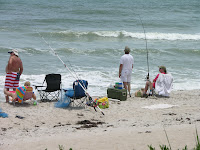 and you can pretty much have any fishing area you like. Only a few fishermen will keep you company as you try your luck. and you can pretty much have any fishing area you like. Only a few fishermen will keep you company as you try your luck. The larger whiting are still hitting well but the surf will be a problem with the hurricanes and tropical storms wandering around our area. This past week there were 6 foot seas a couple of days and the rip currents reportedly took a couple of lives. Be careful!
Short casts between the breakers in the troughs with light line and just enough lead to keep the bait on bottom will often produce if you can't make long casts past the breakers.
Eddy Creek fishermen are still catching trout, some bluefish, whiting, and larger redfish around Cucumber Island and Whale's Tail.
Offshore Fishing
Scattered cobia and king mackerel will be striking live menhaden slow trolled in the 40- to 90-foot reefs, wrecks and shoals from due east of the Port northward to Chris Benson Reef. The fish are not yet concentrated, so keep moving until you start getting strikes. Mangroves snapper and black sea bass are hitting cut sardines and squid on the reefs in the 50- to 90-foot depths. Amberjack have been holding in 120 to 180 feet of water, on the wrecks. Vertical speed jigs, like the Butterfly or Benthos models will do the job well.  Yellowfin tuna will still be on the agenda throughout September out of Port Canaveral on the east side of the Gulfstream. The largest concentrations should still be found 70 to 90 miles offshore. Yellowfin tuna will still be on the agenda throughout September out of Port Canaveral on the east side of the Gulfstream. The largest concentrations should still be found 70 to 90 miles offshore. Sea birds circling the bait pods are a dead giveaway that fish are in the area and trolling a 9" to 12" purple or black plug, 10 to 12 knots around the schools will still produce fish in the 40 to 100 pound range. King mackerel in the 15 lb. range out of Port Canaveral, will still be found in about 60 to 90 feet of water. Some larger 40 lb. smoker kings will still be moving closer to shore chasing the concentrations of finger mullet. _________________________
Still keeping an eye out for oppressive Government control on where, when, and how we are "allowed" to fish in our waters.
Here is the latest infringment on our fishing rights:
 OnAugust 23, 2010, the Environmental Protection Agency (EPA) was petitioned by the Center for Biological Diversity and four other organizations, to ban all lead in fishing tackle under the ToxicSubstances Control Act.
This includes sinkers, jigs, weighted fly line,and components that contain lead such as brass and ballast in a widevariety of lures, including spinners, stick baits and more.
It is important that anglers send your comments now! Let your voice be heard! On August 27, 2010, the EPA denied the petition for ammunition but maintained the petition to ban lead fishing tackle. Supporters of hunting and the shooting sports have been successful in having ammunition excluded from this ban. The petition was presented with the aim of reducing bird deaths caused by the ingestion of lead sinkers and jigheads; however, a study conducted by the U.S. Fish and Wildlife Service found that less than one percent of all waterfowl and other birds such as eagles are killed by lead sinker ingestion. The reasons for opposing the ban are:
Anglers are encouraged to support voluntary angler education programs for the use of lead sinkers and should urge state and federal fish and wildlife agencies to do the same. How You Can Help
The EPA has opened the petition for public comments. Please take the following two simple steps to oppose this ban.
Template Message The petitioners' document is replete with commentary unsupported by scientific data and rife with misunderstandings about the use of lead sinkers. Although the petition is aimed at reducing waterfowl death from lead sinker ingestion, a study by the U.S. Fish and Wildlife Service has shown that less than one percent of birds die from ingested sinkers. Lead fishing tackle does not present a population level problem to any bird species. In fact, loon populations are increasing throughout their breeding range. If a particular body of water is of concern, the issue is most effectively addressed by a local science-driven process, not a national ban. Fisheries and recreational fishing methods are best managed by state agencies. While supporters of this ban claim that there are many comparable alternatives to lead sinkers and jigs, this is not the case. Depending on the alternative metal and current prevailing raw material costs, non-lead fishing tackle products can cost from six to 15 times more than lead products. Non-lead products may not be as available and most do not perform as well. Mandatory transitioning to non-lead fishing tackle would require significant - and costly - changes from both the industry and anglers. The resultant decrease of fishing tackle purchases will diminish the dollars for fisheries conservation through fishing license sales and the federal manufacturers' excise tax on fishing equipment. Something our country can ill afford. I urge you to deny the lead ban petition, because it will have a significant negative impact on the recreational fishing community and only a negligible impact on waterfowl populations. Thank you for your consideration.
WE CAN MAKE A DIFFERENCE!
Tight Lines To You All!
| ||||||||


| Link One | Link Two | Link Three | Link Four | Link Five | Unsubscribe to this newsletter |