Your July 2010 Mosquito Lagoon & Indian River Fishing Report
Published: Thu, 07/01/10
| Newsletter Issue #11 Fishing Forecast |
July 1, 2010 | |||||||
Mosquito Lagoon & Indian River Fishing | ||||||||
he Mosquito & Indian River Lagoons
July fishing is noted for hot, humid days on the water with late afternoon thunderstorms moving across the landscape like clockwork.
Redfish are eating cut ladyfish on the edges of the shallow bars in both of our lagoon systems.
Big Trout action in the Banana River around the deeper flats, in and around the Thousand Islands area at Cocoa Beach, is very good right now, and is expected to get better as July progresses. Top water Chug Bugs, Skitter Walks, and Mirror Lures are baits of choice early in the mornings.
There are also schools of glass minnows that are now showing up in the Central portions of the Banana and Indian River that are bringing in a variety of hungry game fish willing to eat, when you can find the schools.
There is a lot of bait in both the Mosquito and Indian River Lagoons right now, which is both good and bad.
The redfish and
trout are all over the place eating bait fish, but the fishing has slowed down a bit since the full moon night feeding binges have ended.
Top water lures, gulp baits, and anything that resembles a baitfish will catch fish. If you can get some pigfish at a reasonable price, they are still the best choice for large gator trout that cruise the edges of the flats looking for a meal. Baby croaker , pinfish, and large live shrimp are good alternative choices.
My neighbor caught eleven redfish on a gold colored Johnson Silver Minnow spoon, along with some ladyfish, and a couple of nice seatrout the other day; and is expecting the fishing to get even better after the July 4th holidays.
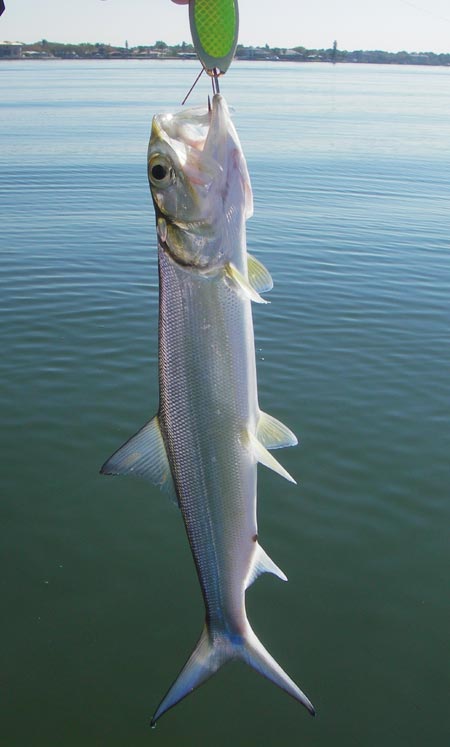 Ladyfish are thick in some areas of the Mosquito Lagoon, along with some jacks and bluefish running under the bait
schools. Ladyfish are thick in some areas of the Mosquito Lagoon, along with some jacks and bluefish running under the bait
schools. To catch the ladyfish, reel fast. Unlike sea trout that go for a slow bounce type presentation; Ladyfish generally prefer a fast retrieve.
The best times to fish are before daylight, till about 9:00am and then late in the afternoon just before dark, till about 1:00am in the morning.
I recently got an email from a reader who said he seldom fishes during the daylight hours and prefers night fishing exclusively in the Haulover Canal area.
He reports that he has charted the bottom of the canal and has pulled out many trophy size fish;
largest- Red ( 37 1/2 lbs), Black Drum (37 1/2 lbs) and Trout( 7 lbs) , Snook
32",Grouper 4 1/2 lbs., and "also one time pulled up a Stone Crab, who's claw could go
around my wrist." I don't know about the stone crab claw, but I can attest to the voracity of the other fish from my own personal fishing experience.
Night fishing is more productive, cooler, and you don't have to put up with the other boaters. Just keep the mosquito spray handy! They didn't name the Mosquito Lagoon for nothing!
The best redfish I ever landed was caught in the Haulover Canal using a whole ladyfish for bait, with the tail removed. The fish measured in at 47" and was caught on the south east side of the canal bridge from the bank; about 40 yards from the mouth of the Mosquito Lagoon side.
I didn't have my camera with me and took pics with my cell phone which I later broke and had replaced. Unfortunately, the pictures went with the phone. The fish was similar to this 44" one. The Shiloh Marsh Road and Peacocks Pocket bank fishermen have been taking slot sized and oversized Black Drum on a regular basis from the Indian River lagoon. The kayakers
 I have spoken with, tell me they occasionally see small schools of larger redfish and black drum working schools of mullet into the shallows. I have spoken with, tell me they occasionally see small schools of larger redfish and black drum working schools of mullet into the shallows. If you can jump one of these schools from the bank, you can have a blast with them.
Up until I screwed up my shoulder I had been catching some decent fish on artificial lures.
My wife has been catching trout, redfish and black drum with her Cajun Thunder bobber rig and dead shrimp for bait. The fishing in both the Lagoons will get progressively better throughout the month of July. Shrimping on the Indian River has come to a standstill. Most of the shrimping activity is in the Haulover Canal along the northwest bank and at both mouths, depending on the direction of the current.
The fishing pier appears to be completed, but although the resturant and lounge is open for business, and the lights on the new pier are on; the pier is still closed to traffic. 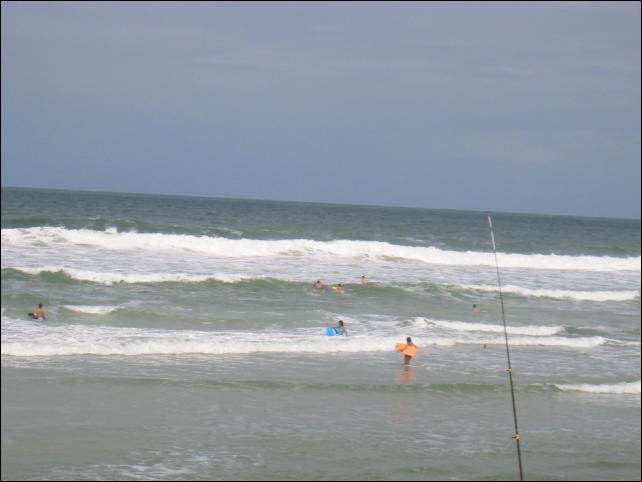 Playalinda Beach fishing for whiting and bluefish will continue to improve. The larger whiting have been hitting on small pieces of peeled shrimp. Bluefish are tapping cut or whole mullet and dead shrimp. Parking lots #8 through #10 are the best areas. Playalinda Beach fishing for whiting and bluefish will continue to improve. The larger whiting have been hitting on small pieces of peeled shrimp. Bluefish are tapping cut or whole mullet and dead shrimp. Parking lots #8 through #10 are the best areas.Use wire leaders or long shanked hooks for the blues and lighter line with smaller hooks for the whiting.
Contrary to popular belief, some of the best whiting can be caught with short casts between the breakers in the troughs with light line and just enough lead to keep the bait on bottom.
Eddy Creek fishermen are catching trout, blues, whiting, and grouper in area near the canoe launch.
Near Shore Fishing out of Port Canaveral is expected to pick up as the holiday weekend arrives.
The fishing conditions
near-shore along the beach out of Port Canaveral has changed, just like the tides. In June's report, the water conditions were warmer, the seas were flat enough for small flats boats to venture offshore, and the fish were hungry.
Well, as of this past week, the water temperatures dropped from the
low 80's to the mid 70's, live bait is getting harder to find, and
the kingfish have just about disappeared from the scene.
The seas have increased to a steady 3 to 4 feet, where it is expected to remain until at least this Saturday. Hopefully, things will calm down for the 4th, and stay calm throughout the rest of month.
The good news is that tarpon and large jacks are still being caught along the beach and the fishing is expected to pick up throughout the month.
This week, the glass minnow schools have begun invading the central portion of the Banana and
Indian rivers.
A variety of species like
gafftop "sail" catfish, tarpon, ladyfish, trout, bluefish and jack
crevalle will be actively feeding on them. You can find these schools by watching for terns and gulls that are diving over the actively feeding fish.
Kill your motor and drift through the areas where this activity is occurring so
that you don’t spook the fish as they feed.
Look for these schools by watching the terns and gulls
that are usually working over the actively feeding fish. Turn your motor
off and drift through the areas where this activity is occurring so
that you don’t spook the fish while they feed. _________________________
Offshore It’s been a few days since I've gotten any good offshore fishing reports. Some king
mackerel are available for guys using live bait on the 60- to 90-foot reefs and
wrecks.
Sea bass, cobia, mangrove snapper and triggerfish are also
hitting on the bottom in these depths. A few dolphin and
sailfish are being caught outside of the 160-foot mark by anglers trolling
ballyhoo baits.
_________________________
Red Snapper Closure Rolls On In what some call the worst-ever federal fisheries
management decision, the South Atlantic red snapper closure continues,
and with additional “shocking†negative twists for Florida anglers.
The South Atlantic Fishery Management Council has voted in favor of continuing the highly controversial total ban on Atlantic red snapper fishing despite overwhelming protests and outrage expressed by veterans on the waters. The latest Council amendment, subject to NOAA/NMFS review, adds still more pain for indignant Floridians. Done at the last minute it now excludes waters off Georgia to an exception to a deep water closure already made for North and South Carolina. (See last month's report)The new version also allows spearfishing, but not hook-and-line fishing, in the offshore broad closure zone off Florida. “The management system is flying blind
and out of control,†said FS Founder Karl Wickstrom.
“They’re still
clinging, for now at least, to discredited science claiming that red
snapper are at 3 percent of historic levels, while virtually all
veterans say populations are far better than any time in memory.†Anyone regularly fishing offshore can readily attest to this.
But some light, however dim, may show at the end of the tunnel. The Council/NMFS is moving forward with a new stock assessment that is supposed to be done in December. The new Sedar 24 is expected to lead to at least some modifications, though the same people who came up with the previous assessment “will still be driving the bus.â€Â
Florida’s representative to the Council, Mark Robson, spoke against the large-area closure but then joined in a 9-4 vote for the overall amendment package that includes it. Dozens of longtime fishers attacked the red snapper ban and area closure as based on erroneous science, such as use of reports from the ‘60s claiming red snapper landings of up to six million pounds, and as low as two million. Among other challenged findings were misstatements about otolith (ear bone) research, recruitment (newcomers to the stock) data, selectivity issues (places of samplings) and supposed “truncation†or reduction of average sizes. PEW Environmental Trust was the only entity favoring the old assessment. It handed out a colorful flyer claiming that red snapper average sizes fell from 19.2 pounds in the ‘60s to only 1.8 pounds today (1.8 pounds is smaller than the minimum 20-inch fish weight). PEW said the size collapse numbers came from NMFS data, but Florida Sportsman found no such research resembling those figures. NMFS charts and tables do not depict any significant reduction in average size. On the contrary, last year’s “summer study†of actual catches, observed by NMFS, produced red snapper many times larger than the “practically non-existent†fish claimed in the assessment. Opposition to the assessment and resultant closures was bolstered by articles of three university professors, Drs. Ray Waldner, Tom Chesnes and William (Trey) Kenney which were reported in Florida Sportsman Magazine. Their fine work and protests from many other quarters led to the Sedar 24 assessment due in December. “So fishing conservationists must re-double their efforts,†Wickstrom said. “This is no time to give up the ship Hope you all get to enjoy the 4th.
Till Next Month, Good Fishing While We Still Can & Tight Lines To You All! | ||||||||
 The large-area closure for Florida if
approved by NMFS will ban all bottom fishing by anglers and yet still
allow fish traps, called black sea bass “pots.â€Â
The large-area closure for Florida if
approved by NMFS will ban all bottom fishing by anglers and yet still
allow fish traps, called black sea bass “pots.†| Link One | Link Two | Link Three | Link Four | Link Five | Unsubscribe to this newsletter |