Your May 2010 Mosquito Lagoon & Indian River Fishing Report
Published: Tue, 06/01/10
| Newsletter Issue #10 Fishing Forecast |
June 1, 2010 | |||||||
Mosquito Lagoon & Indian River Fishing | ||||||||
he Mosquito & Indian River Lagoons
June brings with it the heat, humidity, and late afternoon thundershowers that the Mosquito Lagoon and Indian River Lagoon is noted for.
Along with this weather will come countless angling opportunities on all fronts throughout East Central Florida's, Space Coast. The flats, inshore, near shore, and offshore fishing will improve dramatically, as the early June winds calm down and produce smoother seas and inshore waters.
These smooth conditions greatly improve the ability of anglers to locate schooling redfish and other flats species. Spotting fish movement on the shallow flats from a long distances, becomes much easier as the month progresses. 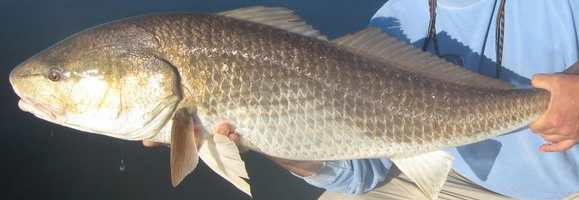 The larger Mosquito Lagoon redfish have started to form up into their summer breeding schools in their usual locations.
Right now, small groups of 15 to 20 breeder fish can be consistently spotted if you know where to look: but they have been fished hard and are difficult to catch with lures.
Live and dead baits are better choices for these larger "bull" redfish. In the Mosquito Lagoon especially, these breeders have been around the block once or twice, and have seen just about every fly, plug, spoon, or soft bait known to man.
Live finger mullet, croaker, grunt, shrimp or pinfish on light lines and 5/0 hooks will usually do the trick when you strike out with artificial lures.
 Fresh cut ladyfish, mullet, or shrimp also work well, but have a tendency to pick up unwanted catfish, rays, and some unlikely catches for this area like Sea Robins and Green Eels. Fresh cut ladyfish, mullet, or shrimp also work well, but have a tendency to pick up unwanted catfish, rays, and some unlikely catches for this area like Sea Robins and Green Eels.The larger Gator sea trout that haven't been killed off by this winter's freeze, are also beginning to get active early in the morning just at first light.
This is due to the fact that the mullet have returned to both the Mosquito and Indian River lagoons, and the fish are returning to their normal summer feeding patterns.
If you are a regular reader, you already know that I prefer fishing top water plugs over any other bait; mainly because of the explosive hits that you get. June is a prime month for this type of early morning and late afternoon fishing, and I love it! Zara Spooks, Rapala Skitterwalks, and Storm Chug Bugs will get more of a workout starting
 next month and throughout the summer. next month and throughout the summer. The best time to fish the shallow flats for gaotr trout and redfish is between 5 am and 9 pm in the mornings, and late in the afternoon, particularly after the thunderstorms move out.
If catching a big Gator Sea Trout is still on your agenda; fishing the grass flats North of the NASA railroad bridge around Mims, to Scotsmoor, Fl. during the wee hours of the morning is still your best bet.
Shiloh Marsh Road bank fishermen have been taking advantage of the weather to tap into some good redfish in the northern most shallows of the Indian river using live finger mullet.
Although the bite is sporadic and "iffy" when bank fishing, some bruisers are being caught by those who have learned that "patience is a virtue". (I am not one of them!)
The kayakers, and canoers that I have spoken to, tell me they occasionally see small schools of larger redfish working mullet into the shallows. If you can jump one of these schools from the bank, you can have a blast with them.
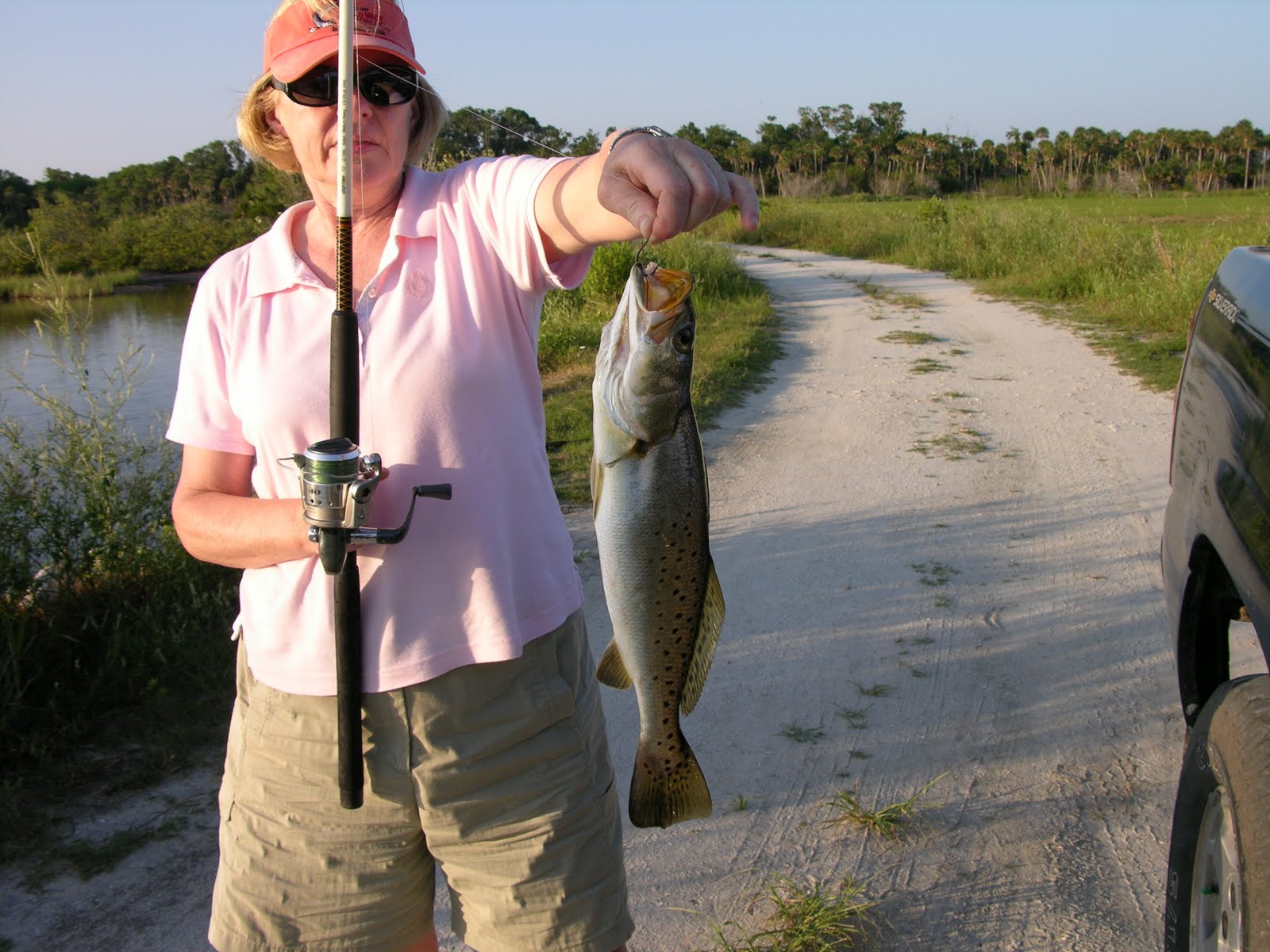 Up until the past couple of weeks, my wife and I have been catching a lot of the larger 18" and over sea trout with her Cajun Thunder bobber rig with shrimp for bait, and my usual spattering of artificial lures. Up until the past couple of weeks, my wife and I have been catching a lot of the larger 18" and over sea trout with her Cajun Thunder bobber rig with shrimp for bait, and my usual spattering of artificial lures.Fly fishermen using Clousers or any type of minnow imitation will do well this month at first light in either of the Lagoons.
Poppers resembling finger mullet should be a killer on any of the flats where schools of mullet are roaming.
Although some Black Drum are still being caught under the bridges in the Indian River system, not many really huge ones have been reported. Shrimping on the Indian River has all but come to a standstill. I have seen one or two die hard shrimpers on the Max Brewer Memorial Parkway Bridge, but for the most part shrimping here has come to a halt. The season has been pretty disappointing from the reports I have received. The fishing pier construction looks like it has been completed, but I
still can't get any information on when it's expected to open. If they allow sport shrimping, I guarantee it will be a hit.
The Haulover Canal seems to be an entirely different story. Every time I drive across the canal bridge, both sides of the canal has been populated with anchored boaters shrimping from their vessels. The north bank of the canal appears to be more favored by the shrimpers.
I know from experience that shrimping in the Haulover Canal is pretty good all year long. The ongoing current constantly funnels the shrimp back and forth through the canal making them easy picking. The last time I shrimped the canal, I got a 5 gallon bucket of mostly jumbos, in only a couple of hours.
Playalinda Beach fishing for Pompano, whiting and bluefish will continue to improve. The
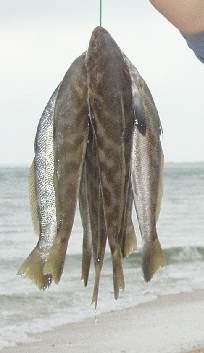 bait pods have started running and more Bluefish, Spanish Mackerel, small Kingfish, and Sharks will be caught in the surf. The larger whiting have been hitting on mostly small pieces of shrimp. bait pods have started running and more Bluefish, Spanish Mackerel, small Kingfish, and Sharks will be caught in the surf. The larger whiting have been hitting on mostly small pieces of shrimp.Near Shore Fishing out of Port Canaveral should is getting better.
June's smoother water conditions will allow those of us with smaller flats boats to venture offshore and either run the beach, or fish the closer near shore reefs without taking any excessive risks.
As the kingfish move in very close to the beach, and
around the Port Canaveral buoy line shadowing the schools of pogies
(Atlantic Menhaden), it's a small craft angler's dream come true.
Historically, May and June are the months where the heaviest "bull" dolphin are caught out of Canaveral and Ponce Inlets.
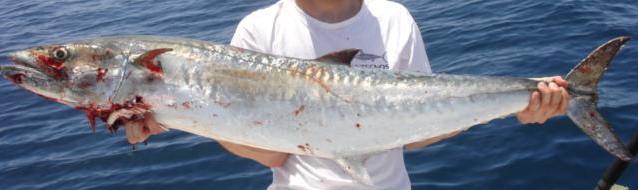 The pogie pods will attract the the larger tarpon and "smoker" kingfish into shallower waters near the beach.
You can catch them slow trolling a 10" to 12" silver mullet, or large diving plugs that run 10 feet or deeper along the beaches around the schools of threadfin (greenies). By 9:00 a.m. the greenies go down and are usually replaced by glass minnows which draw in the schools of Spanish mackerel and false albacore.
When this happens, the "smoker" kingfish start targeting the schools of Spanish mackerel so switch to slow trolling the mackerel schools.
Prime conditions are when the water is clean and clear, the water temperature is 76 to 77 degrees, and there is a light to moderate chop.
The baitfish pods will also draw large sharks, bonito, and jack crevalle to keep you busy when things slack up with the kings. Chunk out a live or cut bait on a wire or heavy florocarbon leader, and see what you can dredge up!
If you just want to enjoy the weather, don't live line a live
mullet or greenie; you won't get the time!
Some whiting lovers I talked to said they like to drift close to the beach and pick up some of the big "bull" whiting and pompano, using jigs and small pieces of shrimp. Personally, I feel that's why God created beaches.
If I'm going to take out my Maverick, I want a tripletail, smoker kingfish, or a shot at a tarpon and nothing less!
_________________________
Offshore
The dolphin bite is expected to slow as the big schools begin to spread out. Kingfish fishing is expected to remain good along the inshore reefs and the wrecks of 8A Reef, and Pelican Flats. Again, slow trolling with live pogies will produce the best action. Bottom fishing for snapper and grouper will remain good until the first summer hurricane blows in and muddies up the water. When the summer doldrums set in, the seas will calm down and flatten out; then as the ocean cleans up you can expect to see some of the best fishing of the year along the beach, reefs, and wrecks offshore.
Hook and Line Ban Proposal Looms Off Florida! At a June 7 - 11 meeting in Orlando, the South Atlantic Fishery Management Council (SAFMC) will be voting on a provision in Amendment 17A, which would prohibit ALL HOOK AND LINE BOTTOM FISHING in 98 feet to 240 feet of water from Melbourne, Fl. through Georgia and excluding South and North Carolina.
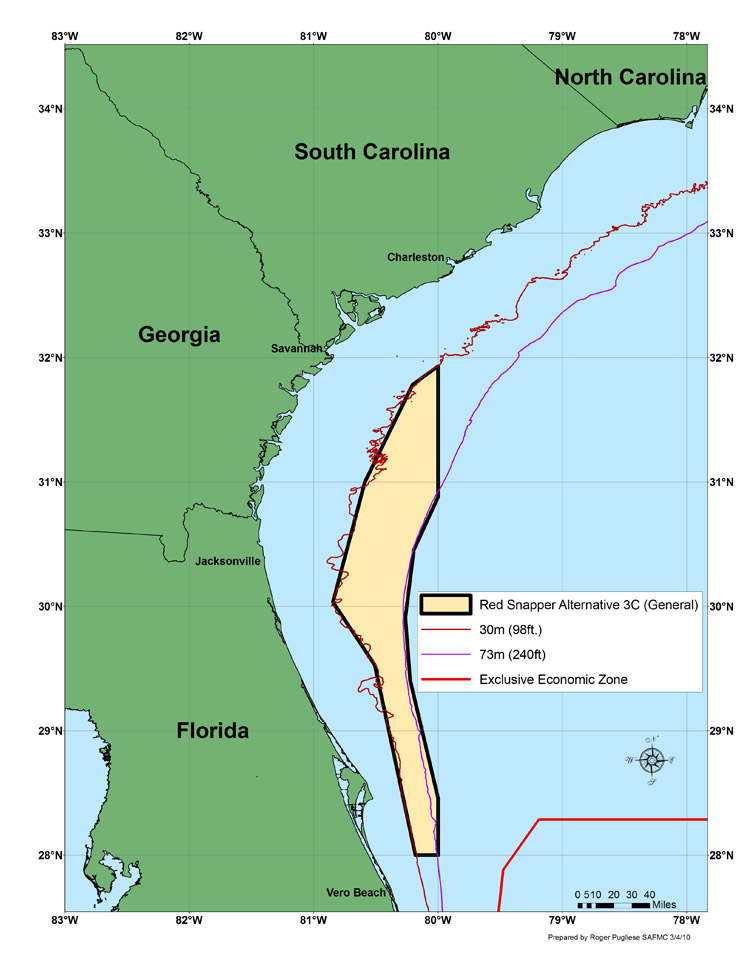 The council is co chaired by a guy from SC and voted in December of 2009 to exempt South Carolina from a drastic prohibition on all hook and line bottom fishing in 98 to 240 feet of water. The council is co chaired by a guy from SC and voted in December of 2009 to exempt South Carolina from a drastic prohibition on all hook and line bottom fishing in 98 to 240 feet of water.The restriction was initially imposed for a section of coastline from Central Florida to North Carolina under the pretext of reducing the red snapper by catch. The latest version of the plan, Alternative 3C, if approved by NMFS, will impose the ban on Florida and Georgia, but not the Carolina s.
The council has also proposed allowing spearfishing to continue in Florida's no hook and line zone, which includes powerheads and explosive projectiles used primarily by commercial fishermen.
The net effect is that Florida's commercial fishermen would be free to fire away while all the hook and line bottom fishermen suffer. Another example of the NIMBY syndrome we get with government regulation.
Till Next Month, Good Fishing While We Still Are Allowed To Fish, & Tight Lines To You All! | ||||||||
| Link One | Link Two | Link Three | Link Four | Link Five | Unsubscribe to this newsletter |