Your March 2010 Mosquito Lagoon & Indian River Fishing Report
Published: Mon, 03/01/10
| Newsletter Issue #7 Fishing Forecast |
March 1, 2010 | |||||||
Mosquito Lagoon & Indian River Fishing | ||||||||
he Indian River Lagoon
estuary has endured and survived many days of freezing temperatures during the month of February.
The loss of spotted sea trout, snook, and tons of puffers due to the freeze in waters too shallow for the fish to get into deeper, warmer water, was pretty severe in some areas.
Shiloh Road finally opened up this month for vehicle traffic, but the reports of bull redfish and gator trout that we normally get this time of year in this area, are few and far between. I've been picking up some slot sized trout using a variety of soft baits and gold spoons, but the female gator trout that inhabit this area have not yet started the spawn.
The Sea Trout should will become the predominant species as they begin their spawn when the warmer spring weather arrives, but for now, the redfish and black drum are the primary targets.
The local guides should start reporting catches of heavy weight Black Drum under the bridges along the Indian River. These 60 to 80 pound female giants, during their spawning cycle, frequent the deep water around the bridges through the end of March.
Two of the best bridges in this area are the railroad bridge going to the Cape just south of Mims, Fl. and the Pineda Causeway bridges that cross the Indian and Banana rivers (SR 404).
The largest drum haunt the deep water along these and other bridges, and will remain in the area well into early summer.
The best way to catch and hold these bruisers is with heavy tackle, large hooks and fresh blue crabs on sliding sinker rigs that you use for offshore grouper fishing. Use minimum 50#
test mono or Power Pro braid, and about 30 to 50 feet of 80# to 100# leader attached to a heavy swivel. Use a 1/2 to 1 oz. barrel sinker and a 6/0 circle hook to finish off the rig. You need the long leaders to keep fish from breaking off on the encrusted pilings which is where they immediately head when hooked.
You can pick up the live crabs at local seafood outlets if the bait houses don't carry them.
Break off all the claws and hook the crab through the corner of the body. Send the bait as close to the piling as you can and hold on!
The Florida record for Black Drum is a 96 pounder caught in Fernandina Beach in 2001 and the current Florida bag limit is 4 fish in the 14" to 24" slot, with 1 fish over 24" allowed per day.
The Mosquito Lagoon fishing will be picking up a bit as the waters warm up. The redfish will be getting easier to find and will still require a stealth approach due to the crystal clear water. The windy and cold conditions this February, made for tough fishing on the Mosquito Lagoon for just about everything.
Some guides I know avoided the lousy weather by soaking blue crabs in deep water sheltered areas with their clients. A couple of 40" redfish were picked up on at least a couple of occasions.
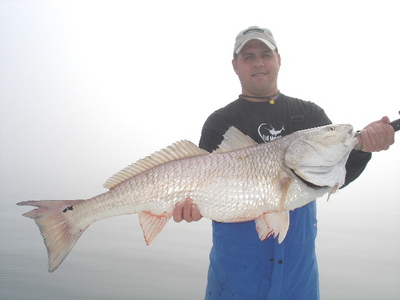 The Haulover Canal area is still the best bet for huge Bull Redfish almost any time of year and even grouper if you know where the ledges are. The Haulover Canal area is still the best bet for huge Bull Redfish almost any time of year and even grouper if you know where the ledges are.Everyone I know is waiting for the weather to even out and the water to warm up. March should bring with it great fishing conditions that we normally experience in both the Lagoons this time of year.
Right now the lures of choice for very shallow water fishing during the warmest part of the day are gold colored Red Ripper spoons, D.O.A. shrimp, and Riptide weedless jigs. Fish everything very, very slowly, on lighter than normal line using long casts. Live baits, particularly grunt, will "call up" gator trout that survived the cold snaps, and live shrimp always produce on the flats when the fish aren't interested in artificials.
Shrimping is getting better on the Indian River but the drawbridge on the Max Brewer Memorial Parkway Bridge has been stuck in the open position for the past week or so, and the bridge has been closed to traffic.
Friday evening when I went down to visit the local shrimpers, there were none because of the bridge closure. I was hoping to catch a few of the sea trout for dinner and didn't even get a bite.
The work on the new fishing pier has been progressing nicely and hopefully will be completed by summer. No one I know seems to have any idea as to when the bridge will be fixed. I would hate to be working at NASA during the bridge closure. It's a long haul taking the alternate route on US1 over Haulover Canal to the Cape.
Playalinda Beach fishing will be great for Pompano throughout March and when the bait pods start running, we can expect Bluefish and Spanish Mackerel in the surf.
I haven't had any reliable fishing reports from Playalinda anglers that I can vouch for so I'll leave that open, however March should be better for the Whiting as the waters get to 68 degrees or so.
The St. John's River shad run is getting better, but still not like it was in prior years.
Although the American Shad in the St. John's River is still near the beginning of the run, locals are predicting it will pick up during the month of March. Crappie fishing has been picking up and will get better throughout the month of March.
A Shad Derby was scheduled for February 20th at CS Lee Park in east of Geneva
on Hwy 46, however I did not personally attend. My neighbor is an ardent shad fisherman and said both crappie and shad fishing has been getting better throughout this month. I can only assume March will continue to get better.
________________________ Near Offshore Fishing out of Port Canaveral should be great if water temperatures get between 68 to 70 degrees, and if we get clean water and calmer seas.
Everyone is waiting for the Cobia to arrive during March. If the large Manta Rays start moving inshore, you can expect them in greater numbers. Cobia are notorious for shadowing the large Mantas.
You can also add Kingfish, Tarpon, and Tripletail to the springtime inshore list starting in March.
The Kingfish and Tarpon will be following the bait pods of pogies, mullet and herring that migrate down the coast just offshore.
 Port Canaveral is also getting to be a world class Tripletail hotspot. These tasty "leaf fish" are popular with small boat anglers because of their proximity to floating debris, seaweed, and the marker buoys along the ship's channel. Port Canaveral is also getting to be a world class Tripletail hotspot. These tasty "leaf fish" are popular with small boat anglers because of their proximity to floating debris, seaweed, and the marker buoys along the ship's channel. Catch them with live or dead shrimp, small jigs, and my favorite D.O.A. shrimp, fished on light 8 to 10# line. These guys are a blast and can't be beat on a dinner plate.
Till Next Month, Good Fishing & Tight Lines! | ||||||||

| Link One | Link Two | Link Three | Link Four | Link Five | Unsubscribe to this newsletter |